38. Release Notes
SeligSIM
RC Flight Simulator
https://www.seligsim.com
https://www.seligsim.com/download.html
Earlier versions of SeligSIM are also marketed under the brand FS One®.
For UPDATES and NEWS, subscribe to the Selig’s Newsletter on Substack:
https://michaelselig.substack.com/
38.1. SeligSIM 2026
38.1.1. SeligSIM 2026a (v20.1)
Download from the SeligSIM download page
September 20, 2026 (rev 6571)
This new major release includes all prior releases, updates, and DLC.
This 2026a version includes all changes since SeligSIM 2024.5b (v18.4, rev 4045).
All prior DLC are built in, the indoor flying sites and the orange sunburst Pawnee. New DLC will be released separately.
Installer file is named SeligSIM_2026a-20-1_Full_Installer.iso. It installs to C:\SeligSIM 2026 and runs beside any earlier version of SeligSIM or FS One.
Run the installer directly with standard permissions. No admin rights needed.
How this new version is named:
SeligSIM 2026 - Software named for release year
SeligSIM 2026a - First release (a) for this major release 2026
v20 - Version number that counts from year first released (2006)
v20.1 - First release of version 20
rev 6571 - 6571st rev to the software repository since 12/2009
Controller Mapping
Added the USB Interface Mapping window, reached from Mapping on the Main Menu. It replaces the external remapping programs used with earlier versions. Drag each stick, switch, knob, or button of your real USB device onto one of the sim’s eight axes and calibrate with one sweep. The result appears in the USB interface list as “Mapped - <device>”, calibrated for both pilots. See Getting Started: Part I.
The Mapping window opens a 3D airplane (Show A/C) flown by the mapping as you build it. Raw counts and a jitter band per axis expose noisy or dead axes. Mapped rows track whether you have swept each control to both limits. A calibration in progress can no longer be lost by accident.
Added the “move it and click it” live picker for a channel’s input in the Edit Transmitter window. Wiggle a control, watch its slider light up, and click it.
A Menu Bar, In Flight
Added a desktop-style menu bar during a Flight Session with the Simulation, Aircraft, Transmitter, Cameras, Widgets, World, Physics, Recorder, and Help menus, plus Pilot 2 in two pilot sessions. Items show their keyboard key, so the menu doubles as a live key reference. Nearly every keyboard shortcut is on the menu.
Hold items (zoom, wind, sun, trims, winch reel) keep acting while the mouse button is held. Menus with checkmarks stay open. Every slider in the menus has arrow buttons that step one unit per click.
Added settings windows you can open in flight, each with the same four buttons (Power Tools values, Defaults or All Off, Save Settings, Reload Saved Settings), and none of them changes Power Tools. They are Widgets | Widget Sizes… (one slider per widget, the HUD, and the Data Monitor text), Widgets | Orientation Map | Settings…, Simulation | Data Monitor Settings… (which of the 80 readouts show), and the Markers… and Developer Overlays… windows on the new Physics menu, which also holds Disable Gravity.
More Power Tools settings are now live in the menus. World | Shadows (sharp, soft, or projected on terrain), World | Sky Rotation (turn a 3D site’s sky dome, sun and lighting with it), World | Windsock, Widgets | Wind Vectors (the grid of red wind arrows), the Attitude Indicator flight path marker, and the two Home Arrow rows under Widgets | HUD.
The flight path trace has a Generate row on the Recorder menu (it starts fresh from the airplane’s position). The menu also has flight path trace Save and Load.
Added Open Tx Basics / Open Tx Full to lay out sets of transmitter panels with one click, and Close All.
Added Help | Keyboard Shortcuts (or the
/key), a live Keyboard Shortcuts window built from the sim’s own key bindings every time it opens, with a filter box. It replaces the painted key-map pages.Redid the printed keymap graphic in two layouts, the main keyboard and a second sheet for the Left Shift layer. Both are in the Help folder of the install as PDF and PNG.
New In-Flight Instruments and Panels
All are draggable, reopen where you left them, and start where Power Tools says. See Widgets and Tools.
Added the Wind Meter (Left Shift + W). It shows the wind at your airplane as an aviation-style direction/speed/gust readout, a speed scale with lull/average/peak markers, and a strip chart. Wind can be sampled at the airplane, at a 10 m field mast, or at a handheld height.
Added the Attitude Indicator (Left Shift + Y) with pitch ladder, bank scale, and a flight path marker.
Added the Orientation Map (Left Shift + M), a circular map centered on your airplane, nose up. Press again for north-up.
Added the Field Radar as the new default overhead map (M), a stable, pilot-centered radar scope with range rings, an off-map arrow, and a North marker. The five maps are named the same on the map, in the menu, and in Power Tools.
Added Height & Distance (Left Shift + H), the Wireframe Airplane (Left Shift + P, with Off/Always/Auto modes), Servos (Left Shift + S), Flight Modes & Channels (Left Shift + C), Flight Modes & Mixes (Left Shift + F), Deflections (Left Shift + D), Flight Modes & Rates/Expos (Left Shift + E), Flight Modes & Offsets (Left Shift + T), Flight Manual (Left Shift + I, built from your controller), Axes (Left Shift + A), Mix Bench (Left Shift + X), Mix Map (Left Shift + Z), the Airplane Specifications panel (Left Shift + KP /), and Screencast Keys (Left Shift + /), which shows every key you press with the action it ran.
The Replay Panel (Backspace) and the Transmitter Display (E) are now full widgets with a Power Tools start position and memory.
The Data Monitor and the right-edge readouts are one aligned panel. Its first row reports the real physics rate.
HUD messages age in place, so the stack never jumps while you read it.
Borderless widgets outline themselves in cyan while dragged.
Screenshots
Added Simulation | Capture Screenshot (JPG or BMP) to the new Screenshots folder, an automatic capture a set delay after each flight starts, and filenames built from tokens with a live preview in Power Tools.
Cameras and Views
Added Snap Views. Hold V (pilot position), G (horizon), Y (windsock), or T (landing target) to look, and release to swing back.
Keep Ground In View (KGIV) cameras now lead the F3 pilot-view list, and KGIV-1 is the F3 default.
The mouse scroll wheel moves the camera closer or farther on the chase and onboard views.
Added two camera lags (mouse pointing, and the B/N distance keys) with sliders in Power Tools. A right click while flying toggles them.
Polished mouse view steering (F7). The pointer recenters itself, each camera remembers its own view direction, and running windowed no longer swings the view when the pointer leaves the window.
View cameras 11 and 12 now work at the PanoX panorama sites.
Graphics
Fixed washed-out colors on NVIDIA graphics at the source. No driver setting, Reshade filter, or overlay is needed anymore (remove one if you added it, or the picture will now be too dark).
High-resolution monitors at any Windows display scaling now work without the “Override high DPI scaling” compatibility setting, and a windowed sim renders at exactly the size you asked for.
Aircraft textures are sharper and no longer shimmer. They are mipmapped and drawn with 16x anisotropic filtering.
The airplane’s shadow is a three-way choice in Power Tools, sharp edges, soft edges, or projected on terrain.
The menu screens redraw at 60 frames per second (was 30).
Flying and the World
Added moving the sun while flying. Left Shift + Home/End raises and lowers it, and Left Shift + = / - moves it around. Added one-click Reset Sun and Reset Wind.
Added World | Thermals in 3D, drawing each thermal as a translucent column shaped by its usable lift, plus thermals on the field maps and the Orientation Map.
Towed launches show a pull-force bar automatically. It and the Towline Tension Plot linger 30 seconds after the line releases, long enough to read the peak pull after the launch.
On hi-start launches, the backquote key walks the anchor out to stretch the line (Left Shift + backquote eases it back in).
Added Hand Launch Settings (Left Shift + K) to tune the throw without leaving the flight.
Wheel brakes engage at the same stick position in every flight mode.
English / Metric Units
Added a units choice in Options | Physics, or flip them for the session with Left Shift + U. All readouts follow. Names and descriptions of aircraft, winds, and flying sites show both systems.
Menus and Selection Screens
Added quick search everywhere. On the setup screens, A = airplanes, D = flying sites, S = sun/sky, and W = winds. F filters each selection screen, T opens Transmitter Selection, and R the Recordings window.
Press and release Alt on any menu screen for keyboard labels. Enter, Enter takes you from a cold start into a flight.
Added a “Recent” category leading the aircraft, site, sky, and radio dropdowns, in amber.
Added the purple Select Default Transmitter button and the Default Tx / Custom Tx tags on the Transmitter Selection window.
Every dropdown and text box now works like a standard Windows control, with full clipboard support.
Added license acceptance at first run and one-time lesson safety notices. Lessons run clean-screen.
Transmitter Editing
Flight-mode renames keep their settings, modes reorder with Move Up/Down, copies get real descriptions, the Delete button works again, and the editor’s floating panels stay live while you edit.
SeligSIM Power Tools (SeligSIM_PT.exe)
Added a search box (Ctrl + F) that finds any option by name, section, settings key, or help text and jumps to it.
Reorganized Widgets and Tools into Startup Widgets, Widget Sizes, Widget Positions, Widget Options, and Menu Screen Panes, in the same order as the in-flight menus, with per-group Defaults / Uncheck All buttons.
Clicking a Background Transmitter Image radio button previews it.
Fixes Worth Knowing
Closing the sim from the Windows taskbar now really closes the sim.
Missing or unreadable files show a readable error dialog naming the file.
Fixed stuck Shift keys, Caps Lock digits typing symbols, keys held across an Alt+Tab, and the disappearing mouse pointer.
Controllers with “/” in their USB name (Jeti) now calibrate.
Calibrating an original FS One V2 interface needs the Universal Tx selected. With any other radio highlighted, a click on Calibrate says “Select Universal Tx First”.
The keypad rudder-trim keys now match their directions (KP 4 = left).
The Tracon sailplanes no longer lose their crow brakes to key 6.
The Aerobird, Ascent, Firebird, J3Cub, SloV airplanes properly show their on-screen sticks move.
Stick-recording playback (the comma key) always launches in the recorded direction. In a rare case (a very quick tap, about one in thirty), the recorded velocity was rotated using the orientation the airplane had before the jump instead of the recorded orientation, so it set off sideways or tail-first. The velocity itself was right. Present since 2013.
Key Changes to Note
Right Shift is the Pilot 2 modifier (bare keys drive Pilot 1).
Snap Views took the bare V / G / Y / T keys. The displays they replaced moved to Left Shift (vario = Left Shift + V, sky grid = Left Shift + G, timers = Left Shift + L).
Tow-hook release is now plain Q. Sound mute moved to Insert.
Rewind moved off the keyboard into the Aircraft menu (hold).
The / key opens the Keyboard Shortcuts window (it used to cycle the painted key-map pages).
Right Alt now saves the flight path trace and Right Ctrl loads it, the reverse of previous versions.
Left Shift + a letter opens the instruments and panels listed above.
For Content Creators
The Wind and Flying Site list files changed to the bracket format used by the Aircraft and Skies lists. Old numbered NameN= lists are not read by this version.
Each airplane folder now carries a machine-generated AirplaneSpecs.txt. The sim rewrites it at every flight, and editing it has no effect.
Detailed Change List
Everything below is the net change against SeligSIM 2024.5b (v18.4), one statement per bullet, grouped by area. Where a feature was added and later changed before release, only the final state is listed.
In-Flight Menu Bar
Added a desktop-style menu bar in flight: move the mouse to the top of the screen to show the Simulation, Aircraft, Transmitter, Cameras, Widgets, World, Recorder, and Help menus.
Added every mid-flight action to the menus: pause, resets, engine kill, rope release, line tension, fine trims, smoke, transmitter panels, camera selection, zoom, distance, walking, wind, sun, windsock, flight path trace, recording, playback, and every widget, map, and HUD.
Added the keyboard key beside every menu item, so the menu doubles as a live key reference.
Made items that do not apply gray rather than hidden; hovering a grayed item explains why.
Added “(hold)” items (zoom, wind, sun, trims, camera walk, winch reel) that keep acting while the mouse button is held, at the speed of the key they mirror.
Made menus with checkmarks stay open so several widgets can be toggled in one visit while the sim runs behind the menu.
Added a Power Tools “In-Flight Menus” setting: always hide, show when the mouse is at the top of the screen (default), or always show.
Added a Pilot 2 menu in two-pilot sessions: Pilot 2’s specification sheet, flight manual, engine start/kill, rope release, smoke, and resets, with the Right Shift key combinations shown.
Added a Cameras > Viewing entry in two-pilot sessions to choose whose view the camera controls act on.
Added a Cameras > Snap View submenu holding the four hold-to-glance views (Landing Target, Windsock, Horizon, Pilot); hold the item to look, release to swing back, and an item grays with a reason when the field has no windsock or landing target.
Added Cycle Viewed Aircraft (Tab) under Cameras > View Through, and Next / Previous Padlock (Page Up / Page Down) under Padlock Target.
Made the Cameras menu header two lines, what you are viewing through above which camera, so a long recording name no longer stretches the menu.
Added Transmitter > Open Tx Basics (the four Flight Modes panels plus Servos) and Open Tx Full (adds Deflections, Mix Bench, and Mix Map).
Added Close All at the end of the Transmitter and Widgets menus.
Added Transmitter > Reset Panel Positions (that menu’s panels only) and Widgets > Reset All Widget Positions.
Added Tow Force and Towline Tension Plot to the Widgets menu; both gray out on a flight with no launch line.
Added World > Reset Sun, which returns lighting, shadows, and lens flare to the flying site’s startup sun.
Added World > Reset Wind, which returns wind speed and direction to the flying site’s startup wind without reloading the scenario.
Added World > Thermals in 3D: each thermal is drawn as a translucent blue column shaped by its usable lift, with ring lines every 200 ft.
Changed the World menu’s wind line to give the direction the wind blows FROM, and made it clickable to open the Wind Meter.
Added a multiplier tag such as “(1.52x)” to the World menu’s wind line whenever the wind has been changed from the scenario’s authored strength.
Added a Wind Meter submenu under Widgets: Show, scale top, history window, rolling average, current-speed pointer, and where the wind readouts sample.
Added Simulation > Capture Screenshot, Auto Capture, and a capture-delay submenu.
Added Simulation > Hide All Messages, Hide Data Monitor, and Hide All Messages and Data Monitor.
Added Help > Keyboard Shortcuts, User Manual, and Support; each web link shows the address it opens.
Added the keyboard shortcut beside the Field Map, Orientation Map, HUD, Wind Meter, and Units items, not only inside their submenus.
Moved Rewind off the keyboard into Aircraft > Rewind (hold) and, in two-pilot sessions, Pilot 2 > Rewind (hold).
Made Rewind gray unless the aircraft and propeller are indestructible and auto-reset-after-crash is off; hovering shows the missing condition.
Moved the on-screen messages, the Bomb Drop score box, and the Pylon Racing lap board down out of the menu bar’s way.
Made a widget or panel toggled from the menu or by key open on top.
Listed Servos above Deflections, and Mix Map above Mix Bench, in the Transmitter menu.
Listed Sky Grid in the Widgets menu after Replay Panel (it was in World); the Power Tools Startup Widgets list follows the same order.
Listed Default Manual Zoom directly under Auto Zoom Toggle in the Cameras menu, ahead of the Zoom In / Zoom Out hold items.
Listed Replay Panel at the top of the Recorder menu as well, as its own group; same item as the Widgets row, never grayed for “no recording”.
Added a Wind Vectors submenu to the Widgets menu, after Wind Meter: the grid of red arrows around the airplane ( Power Tools > Wind Vectors ) with Show, Grid Size / Spacing / Arrow Scale sliders, an arrows-per- frame readout, and Reset to Power Tools Values; Power Tools sets the startup values.
Added a Sky Rotation slider ( minus 180 to plus 180 degrees ) and Reset Sky to the World menu for 3D sites; the sun turns with the sky, and Reset Sun still returns the sun to where the rotated sky puts it.
Added Flight Path Trace: Generate to the Recorder menu; the trace starts fresh from the airplane’s position when turned on.
Moved the trace rows from the Aircraft menu to the Recorder menu as Flight Path Trace: Save ( Right Alt ) and Flight Path Trace: Load ( Right Ctrl ), under Generate; keys unchanged.
Added left and right arrow buttons beside every slider in the in-flight menus ( Wind Vectors, Sky Rotation ): one unit per click, repeating while held, no wider than before.
Added a Physics menu between World and Recorder; its Markers… item opens a window that switches the CG, datum, contact points and forces, GroundReactions points, hinge pivots and thrust vector markers on and off while you fly, with Point Radius and Force Scale sliders and four buttons ( Power Tools values, All Off, Save Settings, Reload Saved Settings ); colors stay in Power Tools.
Added a Shadows submenu to the World menu: Pilot 1’s shadow method ( Sharp Edges, Soft Edges, Projected on Terrain ), projected softness and texture size, soft edges for Pilot 2 and recordings, and Reset to Power Tools Values, all live.
Added Settings… to the Orientation Map submenu: a window for the disc’s frame, what it shows and its sizes, with Power Tools values, Defaults, Save Settings and Reload Saved Settings; the ring-spacing arrows step 25, 50, 75, 100, 150, 200, 300, 400, 500 ft and on up.
Added Developer Overlays… to the Physics menu: a window switching the eight on-screen developer data overlays on and off in flight.
Added Disable Gravity to the Physics menu, in its own group: gravity off and on in flight, taking effect on the next physics step.
Added Widget Sizes… to the Widgets menu: a window of size sliders for every widget, the HUD and the Data Monitor text; instruments resize as you drag, panels and maps at the next flight, and the window says which is which; one Tx Panels slider sizes all nine transmitter panels.
Added Data Monitor Settings… to the Simulation menu: a window to pick which of the 80 readouts the Data Monitor shows, with its switch and text size.
Made Attitude Indicator a submenu in the Widgets menu: Show and Flight Path Marker ( the green where-it-is-going marker ), live.
Added Home Arrow and Home Arrow Only in Following Views to the HUD submenu: the return-to-home arrow’s two Power Tools switches, live.
Made Windsock a submenu in the World menu: Show, On Field Map, and Direction Cone on Field Map, live.
Reordered the Wind Meter submenu: Current-Speed Marker, History window, Rolling average, then Scale top last.
Keyboard Shortcuts Window and Screencast Keys
Added a live Keyboard Shortcuts window on the / key (and Help > Keyboard Shortcuts), built from the sim’s own key bindings every time it opens, including keys you re-bind in ExpressionMapper.cfg.
Removed the six painted key-map pages from 2011 that the / key used to cycle.
Added a filter box: click it (“Click here and type to filter”) and type “wind” or “shift” to narrow the list; until you click, the keys keep flying the airplane.
Made the Keyboard Shortcuts and Hand Launch Settings windows leave the keyboard to the sim unless you are typing in a box, so Space and the other flight keys keep working with either window open.
Grouped the shortcuts under the manual’s headings (Simulation Control, Wind and Sun, Cameras, View Controls, Widgets and Instruments, Transmitter Panels, and so on), each group collapsible.
Made Esc and / close the window; Esc no longer exits the flight while the window is up.
Added Pilot 2’s Right Shift layer to the window in two-pilot flying.
Added a Screencast Keys readout (Left Shift + /) that shows each key you press with the action it ran, in the lower-left corner.
Made a held key stay on screen while held and a tapped key fade after a few seconds.
Tagged Pilot 2’s actions in amber and showed “Pilot 2 Controls Active” while Right Shift is held.
Made Screencast Keys draw into screenshots and video capture.
Added Power Tools settings for Screencast Keys: on at startup, size, corner position, and linger time.
Changed several Screencast Keys names to say what the key does: / “Keyboard Shortcuts”, M “Field Map”, Tab “Cycle Viewed Aircraft”, F1-F12 “Camera Group F1” to “F12”, Keypad 1 “Aerials (zero air density)”.
Left a few keypad keys without a name in the readout; they show the key alone.
Made the in-flight menus, the Screencast Keys readout, and the Keyboard Shortcuts window use one name per key: Reset-to-Home (Spacebar), Reset-in-Place (U), Release Towline (Q), Fine Trims (was Super Trims), Auto Zoom Toggle, Default Manual Zoom, Decrease / Increase View Distance, Walk Camera <direction>, Increase / Decrease Wind Speed, Rotate Wind Direction Right / Left, Sun Higher / Lower, Airplane Specifications, Height & Distance OSD, and Inset Window.
New Instruments and Panels
All are draggable, reopen where you left them, and have a Power Tools startup checkbox, size, and start position unless noted.
Wireframe Airplane
Added a Wireframe Airplane widget (Left Shift + P): a small transparent square that draws the airplane you are flying as a white line silhouette at its live attitude, as seen from the camera and magnified – binoculars for when the airplane is too far away to read.
Added three modes for it, Off (default), Always, and Auto, which shows the widget by itself whenever the camera-to-airplane range exceeds a threshold and holds it briefly after the airplane comes back inside.
Added a Widgets | Wireframe Airplane submenu: Show, the mode, and the auto range (200 to 1000 ft, shown in meters in Metric).
Made the key an override in Auto mode: it shows or hides the widget until the airplane next crosses the range, then Auto resumes.
Added Power Tools settings for its mode, auto range, linger, size, start position, background opacity, drag outline, and which wireframe file to draw from Graphics\Widgets\Wireframes(an Acro, the default, and a Sailplane ship).
Guarded the P (Pause) key so Left Shift + P does not also pause.
Position Data
Gave the Position Data widget ( ‘ ) a Power Tools start position (Save Position to File Left X / Bottom Y, bottom-left anchored), position memory, and the position readout – the last draggable widget without them. Reset All Widget Positions covers it.
Wind Meter
Added a Wind Meter (Left Shift + W) showing the wind at your airplane: an LED direction/speed/gust readout, a speed scale with lull / average / peak markers, and a strip chart of the last seconds of wind.
Shaded the span from average to peak in orange, so the width of the band is the gustiness.
Added auto-ranging, with - / + buttons for a fixed scale top (10, 15, 20, 30, 40, 60 … mph); the choice is remembered between flights.
Added a Rolling Average setting for gust smoothing (default the 3-second aviation standard).
Added three wind sampling points shared by every wind readout: At Airplane, At Field Mast (10 m / 33 ft), and At Handheld (a height you set, default 6 ft).
Restarted the meter’s history when the sampling point changes, so readings from two heights never mix.
Added Power Tools settings for history length, scale top, the live-speed pointer, and the sampling point.
Attitude Indicator
Added an Attitude Indicator (Left Shift + Y): an artificial horizon with pitch ladder, bank scale, and fixed miniature airplane.
Added a green flight path marker showing the airplane’s actual direction of travel; the gap to the wings is the angle of attack.
Hid the flight path marker below walking speed.
Added a Power Tools checkbox for the flight path marker.
Orientation Map
Added an Orientation Map (Left Shift + M): a circular map centered on your airplane, nose up, with the compass ring, takeoff T, pilot bullseye, wind arrows, sun marker, and view cone turning around it.
Added a second press for a NORTH-UP view centered on the pilot; a third press hides the disc.
Added dashed range rings at a Power Tools spacing, with the outer radius labeled in feet or meters.
Parked a far marker at the disc edge with an outward tick so its direction is never lost.
Added other aircraft (Pilot 2’s airplane, the towplane, recordings) as smaller outlined arrowheads turned to their relative heading.
Added thermals as dashed circles sized to the usable lift at your altitude, and the landing target as an open ring when shown.
Drew your airplane as a BD-5J silhouette seen from above (Power Tools can switch back to an arrowhead).
Added Power Tools settings for ring spacing, line thickness, arrowhead size, wind-speed text size, and which extras are drawn.
Field Map (overhead map, M key)
Added the Field Radar as the new default map (Map 1): a pilot-centered radar scope with range rings, runway up, that steps its range instead of continuously zooming and panning.
Pinned an airplane past the outer ring to the map edge as an arrow labeled with its distance.
Made a reset-to-home snap the range back to the close-in view; a reset-in-place leaves it alone.
Locked the range to frame the whole course during a pylon race.
Added a North marker (orange triangle with “N”) just inside the outer ring, matching the Orientation Map’s.
Renumbered the four previous maps to Maps 2-5 (Runway-Aligned, North-Up, View-Aligned, Aircraft-Aligned); they are off in the M-key cycle by default and can be re-enabled in Power Tools.
Made pressing M name the map that came up (“>>> Map 1: Field Radar <<<” through “>>> Map OFF <<<”), and once at flight start.
Made the five map names read the same on the map, in the M-key message, in the in-flight menu, and in Power Tools.
Added both airplanes to the map in two-pilot modes and single-pilot aerotowing: Pilot 1’s airplane red, Pilot 2’s airplane yellow, each with a fading trail.
Added recording-playback aircraft as light gray ghost triangles.
Added each pilot’s standing position as a red or yellow dot, and Pilot 2’s camera view cone in yellow.
Added the launch line (towline, hi-start, winch) in cyan following the rope’s actual shape, with a white dot at the anchor and a red dot at the free end that marks where the line lies after release.
Added a downwind tail cone to the windsock marker; it disappears in calm air.
Added Power Tools controls for the range-ring diameters, which maps the M key cycles, optional Auto and +/- buttons on the map, pilot dots and dot size, launch-line display and parachute dot size, and the windsock tail cone.
Height & Distance
Added a Height & Distance readout (Left Shift + H): height above the pilot with climb rate, and distance out with ground speed, drawn without a window in the lower-left corner.
Servos
Added a Servos panel (Left Shift + S): one travel bar per servo scaled to its configured limits, plus throttle percent and landing-gear percent down.
Turned a servo pinned at its stop amber.
Added a magenta mark showing where the radio is asking the servo to go versus where it has got to (Power Tools can turn it off).
Flight Modes & Channel I/O
Added a Flight Modes & Channel I/O panel (Left Shift + C): every channel, the axis or key that drives it, and the servos it drives.
Lit a channel when the active flight mode commands it, an active mix drives it, or it is the switch that selected the flight mode.
Added an “SCAS (Gyros)” On/Off row and “(SCAS)” tags on gyro-routed servos.
Flashed the flight-mode pill for a couple of seconds when the mode changes, including at flight start.
Wrote key-driven rows as “Key 6” rather than a bare “6”.
Flight Modes & Mixes, Deflections, Rates & Expo, Offsets
Added in-flight Flight Modes & Mixes (Left Shift + F) and Deflections (Left Shift + D) panels, the same panels as in the Edit Transmitter screen.
Added each flight mode’s and mix’s keyboard key on its row, e.g. “Low Rates (1)”, shown only when the keys are what your controller uses.
Added a Rates & Expo panel (Left Shift + E) listing the flight modes and each channel’s active rate and expo.
Listed every drivable control in Rates & Expo; a control with no rate or expo reads 100 / 0.
Made bright rows the ones the flight-mode switch changes and pale rows the ones fixed in every mode, with a legend line.
Added a Flight Modes & Offsets panel (Left Shift + T): the channel by flight-mode offset matrix.
Added a Power Tools option to show mixes not applicable to the connected controller, marked “(n/a)”; hidden by default.
Changed the note for a mix every flight mode forces on to “Always On” instead of “On by Mode”.
Added a Power Tools choice for Deflections decimals: x.x (new default) or x.xx.
Flight Manual and Axes
Added a Flight Manual panel (Left Shift + I; Right Shift + I for Pilot 2): every stick, switch, knob, and key on your controller and what it does, built live from the loaded airplane and the connected controller.
Added an Axes panel (Left Shift + A): a live position indicator for every mapped axis, labeled with what it drives.
Added a Power Tools checkbox to start the Axes panel showing raw controller counts.
Mix Bench and Mix Map
Added a Mix Bench (Left Shift + X): one mix in full, with the master input, the transfer curve with a live dot, and the slave output against its limits.
Flagged the slave output CLAMPED (excess cut off) or AT RAIL (full travel reached honestly).
Added < and > buttons (and Left Shift + , / .) to page through the radio’s mixes.
Added the slave channel’s arithmetic contributor by contributor: stick, each mix by name with its live share, travel gain, flight-mode offset, and clamp.
Added full parameter cards for crow, aileron-to-flap, elevon, V-tail, and flaperon mixes, with a mini plot per surface.
Added a Mix Map (Left Shift + Z): a grid of every coupling on the radio, lit while the mix is on, that visibly re-wires when the flight mode changes.
Made clicking a Mix Map cell open the Mix Bench on that mix.
Airplane Specs, Replay Panel, Transmitter Display
Added an Airplane Specs panel (Left Shift + Keypad /; Right Shift + Keypad / for Pilot 2) that keeps the Scaling Wizard report on screen as a specification sheet.
Made Keypad / alone still flash the message-style report, now all at once and headed by the airplane’s name.
Separated the two airplanes’ Scaling Wizard reports into blocks, Pilot 2 in dark navy.
Made the Replay Panel (Backspace) and the Transmitter Display (E) full widgets, with a Power Tools start position and position memory.
Changed the E transmitter display to follow Pilot 1’s sticks in freestyle and pylon racing with background recordings; lessons and Recordings playback still show the recorded inputs.
Widget Positions, Sizes, and Memory
Made every draggable widget reopen where you last left it, between flights and across sim restarts; Power Tools says where each starts until you move it.
Added “Onscreen Widgets:” at flight start, saying whether the layout came from Power Tools, from the last flight, or from a playback.
Made the open widgets, chosen Map, Orientation Map mode, HUD, frame-rate readout, and sky grid come back on the next flight in the same run (“Remember open widgets between flights”, on by default).
Made each sim start open the widgets chosen in Power Tools.
Added “Show position numbers in flight”: every widget prints its live position in the same numbers as its Power Tools sliders.
Added a dotted cyan outline while dragging the Transmitter Display, Screencast Keys, Height & Distance, and Wind Compass, each with a Power Tools checkbox.
Added a Power Tools start position for every widget, including the six fixed instruments (Wind Compass, Magnetic Compass, Variometer, Hover Training Assistant, Inset View, Tow Force), Timer, Radar Gun, Landing Target, Field Map, and the three newest panels.
Changed every widget’s default start position to a real flown layout on a 1920 x 1012 window; existing saved positions stay in force until Reset.
Fixed the Hover Training Assistant walking across the screen when its size scalar changed.
Made the Edit Transmitter screen’s panels open at a flown layout and remember where you leave them.
Made the HUD remembered between flights, with the “HUD Selected” message shown once and naming the HUD actually on screen.
HUD, Messages, and Data Monitor
Added a return-to-home arrow with distance below the HUD, pointing toward the pilot; within 10 ft the arrow becomes a ring.
Enabled the home arrow on all seven HUDs, with a Use_HomeArrow line in each HUD .txt file and a global Power Tools checkbox.
Showed the home arrow only in views that follow the airplane (F5-F9); a Power Tools checkbox restores it in every view.
Made HUD messages age in place: an expired line goes blank and the lines below stay put (“Messages Age in Place”, on by default).
Capped the message stack at 16 rows (Power Tools sets the number).
Aligned the Data Monitor and the right-edge readouts (timers, frame rate, RESET STATUS, line tension) into one panel: labels on the left edge, values and units on the right, so decimal points hold still.
Reduced the panel to the width its widest row needs; it widens in whole-character steps if a value outgrows it.
Labeled the frame-rate readout “Frame Rate: 65 FPS” to pair with “Physics Rate: 300 Hz”.
Made the Physics Rate row report the real rate (100 Hz in two-pilot and playback modes) and moved it to the first Data Monitor row.
Removed the plain “Airspeed” Data Monitor row; “Airspeed (U)” is on by default in its place.
Added (?) help text to the three airspeed checkboxes in Power Tools.
Added an “Aircraft Elevation” Data Monitor readout (off by default).
Changed the Data Monitor “Wind Direction” row to the direction the wind blows FROM, 0 to 360, matching the Wind Meter; it printed the TOWARD heading in -180 to 180.
Changed “Hide All Messages” to hide only the messages; added “Hide All Messages and Data Monitor” for the old behavior.
Screenshots
Added Simulation > Capture Screenshot, saving the view (menu not included) to a Screenshots folder as JPG or BMP.
Added automatic capture a set number of simulated seconds after each flight starts (default 3), also switchable from the Simulation menu.
Added a filename designer in Power Tools with the tokens {date}, {time}, {aircraft}, {type}, {site}, {user}, {rev}, and {n}, and a live preview.
Added Timestamped (default) and Catalog filename presets.
Changed the timestamp to the readable SeligSIM_260822-19hr03min55sec.jpg form.
Moved the JPG/BMP choice into the new Screenshots section of Power Tools.
Cameras and Views
Added Snap Views: hold V (pilot position), G (horizon), Y (windsock), or T (landing target) to look, release to swing smoothly back.
Added Right Shift + V/G/Y/T for Pilot 2’s window.
Added Power Tools checkboxes for the Look-at-Windsock and Look-at-Pilot advisory messages.
Added mouse scroll-wheel zoom on the chase and onboard views, in the same steps as the b / n keys.
Added two independent camera lags, Camera Mouse Lag and B/N Distance Lag, each with an Options | General checkbox and a Power Tools time-constant slider (0 to 1 second).
Made a right mouse click while flying toggle both lags off and back on; the lag returns at every flight start.
Made the mouse pointer recenter itself while hidden, so mouse view steering never runs out of room.
Made each camera remember its own view direction across camera switches and panel moves.
Started every flight’s chase view level and straight behind the airplane.
Fixed the chase view (F7) dead-zoning and jumping when swept across an open panel.
Fixed dragging a panel swinging the view behind it.
Fixed a windowed sim swinging the view when the pointer left and re-entered the window.
Stopped the sim pulling the pointer back into its window when parked on another window or monitor.
Fixed the fixed field cameras and the hand-launch aim re-aiming after a camera switch, a panel move, or an Alt+Tab.
Fixed a brief horizon “bob” in the Pilot Lagged/Shifted views as the airplane passed through eye level.
Added a “Keep Ground In View” camera behavior: a shifted camera widens its field of view as the airplane climbs.
Added view cameras 11 and 12 at the PanoX sites (Blanca Crater, Roswell Basin, Jockey’s Ridge, and the DS variants).
Fixed the mouse pointer disappearing for good after switching away from the sim and back.
Added a Power Tools “Mouse hide timeout” setting (default 2.0 s; 0 = never hide).
Graphics and Performance
Fixed washed-out, low-contrast colors on NVIDIA graphics, present for about ten years; no driver setting, Reshade filter, or overlay is needed anymore.
Fixed the sim showing only the lower-left part of its window on high-resolution monitors at Windows display scaling above 100%; the “Override high DPI scaling” compatibility setting is no longer needed.
Made windowed mode render at exactly the requested pixel size on scaled displays.
Improved aircraft textures with mipmaps and 16x anisotropic filtering, so decals and panel lines no longer shimmer.
Added a terrain-following projected shadow for Pilot 1’s airplane that drapes over slopes and cliff edges.
Made the airplane’s shadow (Pilot 1 Shadow in Power Tools) a three-way choice: Sharp edges (original), Soft edges, or Projected on terrain (default), with Softness and Texture size (256 / 512 / 1024, default 1024).
Reduced shadow rendering cost by about half: trees, buildings, and people get one crisp pass, and only aircraft are softened.
Increased the menu-screen frame rate from 30 to 60 Hz (Power Tools slider, 15 to 120).
Made the aerodynamic model about three times faster, with the flight model’s numbers unchanged.
Reduced the cost of turbulent wind by about a third (“Reuse Wind Across RK Stages”, on by default).
Fixed every scrolling list drawing its off-screen rows every frame.
Made the rotating 3D airplane on the selection screens turn at a steady rate regardless of frame rate.
Made the pulsing Fly and Play Game buttons breathe at the same 1.7-second rate on every computer.
Sun, Wind, and Thermals
Added sun movement in flight: Left Shift + Home / End raises and lowers the sun, Left Shift + = / - moves it right and left; the same keys without Shift are the wind controls.
Made moving the sun move the lighting, shadows, and lens flare; the sun painted into the sky panorama stays put.
Made the sun ray rise from the airplane’s start position and hold for five seconds after the last key press.
Posted the final “Sun: Az / El” on screen after a move.
Fixed the wind compass digits truncating instead of rounding, so every wind readout agrees.
Added an optional wind direction readout to the wind compass (Power Tools, off by default): the direction the wind blows FROM, 0 to 360, the same number the Wind Meter shows.
Added Reset Sun, Reset Wind, and Thermals in 3D to the World menu (see In-Flight Menu Bar).
Added an in-flight Sky Rotation slider for 3D sites, seeded from the Power Tools Sky Azimuth Offset; the sun and the painted sky stay together (see In-Flight Menu Bar).
Launching: Towing, Winch, Hi-Start, Hand Launch
Added a pull-force bar for towed launches (winch, hi-start, aerotow): green through the comfortable range, yellow near the maximum, red beyond, with the pull in pounds and as a multiple of the airplane’s weight.
Added an overflow zone to 3x the maximum that flashes when pinned.
Added Power Tools settings for the bar: startup checkbox, maximum as a multiple of weight (default 5x), linger time, and size.
Added hi-start walk-out: the backquote key walks the anchor out to stretch the line; Left Shift + backquote walks it back in.
Remembered the walked-out distance across resets within the session.
Added a Power Tools Walk-Out Speed slider (default 10 ft/sec).
Added the Towline Tension Plot to Power Tools (formerly devoptions.txt only), draggable, with scale and full-scale sliders.
Fixed the winch tension plot’s “Elongation (%)” readout floating above the plot.
Fixed the winch Line Tension and Anchor Tension readouts always showing a false “.1” decimal.
Added a tow-force bar and towline tension plot linger time of 30 seconds after the line releases.
Added “Adjust the toss” under the Standard hand-launch method: arm cocking, throw duration, and peak G, with a Reset: standard button.
Added a “Bank Angle: 25.3 deg ( right )” message on each hand launch or reset when a bank angle or random variation is set.
Added Simulation > Hand Launch Settings, a compact in-flight window holding the Power Tools throw settings: arm cocking duration and distance, throw duration and peak g, bank angle and random variation, angle of attack, the timed elevator preset, the point-of-release marker, and the toss sound. Drag, nudge with the arrows, or Ctrl+click to type.
Made those changes apply to the next launch and last for the run; Power Tools is never changed, and “Power Tools values” / “Standard” buttons restore either set.
Made the window work for hand launch, hi-start, and winch flights; the menu row grays elsewhere.
Added Left Shift + K to open and close the Hand Launch Settings window; the Screencast Keys readout names it “Hand Launch Settings” and the Keyboard Shortcuts window lists it under Simulation Control.
Placed each value’s name in a column beside its slider, with only the number and unit inside the slider, so the knob never covers the name.
Added to the window: Show Hand Launch Force, the launch height relative to the pilot eye, and a Launch Direction section with a live readout of where the throw is aimed (azimuth 0 to 360, elevation), a Fixed Direction checkbox, and azimuth / elevation sliders.
Increased the fixed-direction elevation range to -180 to 180 degrees (was -90 to 90); an exact 90 or 180 is stepped off by 0.1 degree.
Removed the Angle of Attack slider from the window (Power Tools still sets it).
Added Save Settings and Reload Saved Settings to the window: one saved set in Options\HandLaunchSettings.txt, written only when you press Save and read only when you press Reload, so Power Tools still decides how a run starts.
Reordered the window: Arm Cocking, Throw, Launch Height, Attitude at Release, Launch Direction, Elevator Preset, Extras.
Fixed wheel brakes engaging at a different stick position in each flight mode; every airplane now reads the literal elevator stick.
Added Wheel Brake rows to the Servos panel and the brake channels to the Channel I/O panel.
English / Metric Units
Added an English / Metric choice in Options | Physics, applied immediately and remembered.
Added Left Shift + U to toggle units for the session only.
Made the HUDs, Data Monitor, LS2 sailplane HUD, radar gun, winch readouts, tow-force bar, tension plot, wind compass, landing target, maps, hand-launch messages, Scaling Wizard report, variometer, and the Options | Towlines lists follow the units setting.
Kept RPM, AOA, Beta, G, the knots readouts, and propeller diameter in inches in both modes.
Added metric input for Hi-Start Launch Length, Field Elevation, Top of Atmosphere, fog/haze distances, Racer Separation, and smoke puff radius.
Made aircraft names follow the units setting (“143-in Span (44-lb)” becomes “3.63-m Span (20.0-kg)”), with optional Name2Metric / Name3Metric lines in Info.cfg.
Made aircraft, wind, and flying-site descriptions show both systems for everyone: “Span: 66 in (1,676 mm)”, “a 4000 ft (1,219 m) runway”.
Made wind names show both systems: “Steady: 4 mph (6.44 km/h) from North”.
Fixed the Scaling Wizard report mixing units after a mid-flight units switch.
Menus and Selection Screens
Added quick search on the flight-setup screens: A = airplanes, D = flying sites, S = sun/sky, W = winds; type to narrow, arrow keys walk, Enter selects, Escape cancels.
Added F on each selection screen (Aircraft, Flying Site, Sun/Sky, Wind, Transmitter) to search that screen’s list.
Added T (Transmitter Selection) and R (Recordings Selection) on the setup screens, with boxed letter hints on each pane: blue opens a search, black opens a selection window.
Made every search open on your current choice, centered in the list, and scroll the pick to the top of the selection screen afterward.
Added PageUp / PageDown and Home / End in the search windows.
Added a centered “No aircraft name contains …” message when a search matches nothing.
Fixed the search highlight following the mouse without changing the selection.
Fixed a stray line of amber text spilling out of the search list on a long unmatched string.
Improved the search windows: large preview pictures at their proper shape, a plain “Description” heading, more room for wind descriptions, and Select tooltips that name what you are choosing.
Made the transmitter search always include the radio in use and the airplane’s default radio.
Added Alt key tips on every menu screen: press and release Alt to show small labels beside everything reachable from the keyboard.
Added main-menu keys: Enter or F for Single Pilot Freestyle, T for Towplane/Sailplane, G for Games, N for Flight Training, 1/2/3 for the Two Pilot rows, H for Help, and M, L, R, O, A along the bottom.
Made Enter the main button on every screen (Fly, Play Game, OK), so Enter, Enter goes from a cold start into a flight.
Added 1-6 and B on the setup screens, C / E / D / L on the selection screens, 1-9 for the Options and Scaling Wizard pages, and the arrow keys for stepping lessons and the 3D / Pano choice.
Added a Power Tools option to keep the Alt labels on screen permanently.
Added “Recent” as the first category in the Aircraft, Flying Site, Sun/Sky, and Transmitter Selection dropdowns, in amber, newest first; the Wind list pins recent winds at the top.
Added a purple “Select Default Transmitter” button on the Transmitter Selection screen, and pinned the default radio to the top of every category with a “Default Tx” tag.
Added “Default Tx” / “Custom Tx” status tags on the setup screens’ Transmitter pane.
Made every dropdown work like a standard Windows dropdown: opens on the current choice, arrow / PgUp / PgDn / Home / End, type-to-jump, Enter, and Escape.
Added type-to-jump in the file pickers (Select Tx Icon, Load Flight, Load File, Load Single Recording, Select Table).
Made typing in the Recordings Selection window and the Log Book go straight into the Filter box.
Made every text box edit like a standard Windows field: cursor keys, Home / End, Delete, click to place the cursor, word jumps, selection, Ctrl+A, Ctrl+C / X / V, Ctrl+Z undo, and the Insert / Delete classics.
Made naming dialogs reject illegal characters as you type, including ; [ ] which could corrupt the settings files.
Fixed opening the Smoke/Exhaust page and the Scaling Wizard pages dropping the cursor into the first value box.
Fixed the pulsing Fly button sometimes jumping straight to dim.
Changed the Options | Physics units choice to round radio buttons.
Fixed radio-button hover help staying on screen and a dashed focus box after a click.
Made selection-tile text shrink to fit and long hover tips wrap into compact boxes.
Added a hover tip with the full wind description on the flying screens’ Wind box.
Added yellow “NEW” badges on this release’s additions, with an Options | Messages checkbox to hide them.
Added End User License Agreement acceptance at first run, remembered until the license text changes.
Added a one-time lesson Safety Notice and an in-lesson reminder strip, with Options | Messages > Reset Safety Alerts.
Made lessons clean-screen: no menu bar or transmitter panels, just the demonstration, the example transmitter, and the Replay Panel.
Made the Replay Panel open automatically in Recordings playback.
Added mouse rotation, wheel zoom, and double-click reset on the Aircraft Selection screen’s rotating 3D airplane.
Retuned the shipped defaults to a flown configuration: menu bar always on, preset Data Monitor rows, map sizing, radar ring ranges, message timing, and the windsock pole at the home field.
Transmitter Editing
Changed assigning a channel’s input to “move it and click it”: a live picker shows one moving slider per axis; wiggle the stick, click its slider, done.
Added to the picker: the channel name in a box, Undo, per-axis Rev | Norm, Axis / Button / Value input types, and channel switching without closing.
Reordered the channel table: Channel column first, then the Source group (renamed from “Channel Name” and “Interface”).
Reordered the TRANSMITTER columns to put Rates, EXP, and their switches first.
Fixed renaming a flight mode discarding its channel settings.
Made adding or deleting a flight mode take effect immediately.
Added Move Up / Move Down for the flight-mode list.
Added a floating FM & Mixes panel listing every flight mode and mix by name, lit green while active.
Made the FM & Mixes “why” note (Power Tools, Show Mix Why Notes) name the physical input behind a switch-slaved mix (“2-Pos SW”, “Knob”, “Left Stick”) instead of “Condition”, matching the Flight Manual.
Made the green mix squares fit any number of mixes and name the mix on hover.
Added the Deflections, Rates & Expo, Channel I/O, and Flight Modes & Offsets panels behind the FM & Mixes button, updating as you type.
Added a Mix Bench button that opens the Mix Bench and Mix Map as a pair.
Removed the Calibrate button from the Edit Transmitter screen; calibration lives on the Transmitter Selection screen.
Made the Interface button shown by default.
Added mouse rotation, wheel zoom, corner and top-strip dragging, and double-click reset in the Show A/C window; removed its four green arrow buttons.
Added Power Tools Background (Light or Grid + Horizon) and Body Axes settings for the Show A/C pane and the Aircraft Selection pane.
Made Show A/C reopen where you left it after saving edits.
Made copying a transmitter write a real description (name, airplane, source radio, interface and axis count, date), with the real hardware and the virtual device on separate lines for mapped controllers.
Added a live preview to the Description dialog.
Fixed the Delete button on the Transmitter Selection screen doing nothing since 2024; overwriting a name during a copy now clears the old files first.
Made deleting a custom transmitter land on the airplane’s default radio.
Fixed a category with no matching transmitters keeping the previous category’s list.
Fixed garbled Source cells (“nown > 1.(”) for hardware-adaptive input expressions.
Added a notice when the setup uses more axes than the selected interface provides.
Fixed a crash on clicking Ok after editing or copying a transmitter.
Fixed a stray red border in the Expression Editor and Select Core Expression dialogs; moved “Tx Channel” to the top of the operand list.
Made the Tx Icon list walk with the arrow keys and ignore mouse hover.
Removed the “Edit Transmitter before Calibration” reminder.
Renamed the transmitter category “Version 2024” to “Version 2026”.
Renamed the gear mixes for the key that works them (“4Key to Gear”) and dropped the internal “(Slave)” tag from channel names.
USB Interface Mapping and Calibration
Added a Show A/C button on the Mapping screen: a 3D airplane flown by the mapping as you build it (P-51 by default, engine and propeller modeled, K kills the engine).
Added Power Tools settings for the Mapping Show A/C pane: sample airplane, size, engine sound, background, body axes, and opening view.
Added a checked marker per mapped row: a hollow ring until the control has been moved to both limits, then a filled green dot, with a running count.
Added a Raw Counts checkbox showing each axis’s live number beside the physical axis and beside the mapped function.
Added a jitter band behind each slider showing the range the axis moved over the last few seconds, with five Power Tools controls.
Added an optional numeric jitter readout (“1842 +/- 6”).
Added the controller’s count range and resolution (“Counts 0…4095 (approx 12-bit)”), one line per resolution group.
Reported an axis that never moved in calibration as “no movement in calibration” instead of a made-up range.
Hardened a calibration in progress: an amber pulsing Finish Calibration button, an amber pane border, and a Stay-default confirmation on Ok.
Added first-visit coaching lines and an amber-glowing Instructions button until the first control is mapped.
Added an Instructions step on working down the rows from the top.
Fixed the Show A/C airplane ignoring the controls on a fresh install until the screen was reopened.
Fixed duplicate “Mapped - …” interface entries for controllers that appear as several same-named devices.
Fixed controllers with “/” in their USB name (Jeti) failing to save their calibration.
Removed the shipped empty “Jeti DC” workaround folder.
Widened the device dropdown and aligned the column headings.
Changed calibration on an original FS One v2 interface to require the Universal Tx: with another transmitter selected, Calibrate shows “Select Universal Tx First” instead of starting. USB and mapped interfaces are unaffected.
Power Tools
Reorganized Widgets and Tools into Startup Widgets, Widget Sizes, Widget Positions, Widget Options, and Menu Screen Panes, with every widget under the same name and in the same order as the in-flight menus.
Renamed widgets to match the sim: Timer, Replay Panel, Landing Target, Hover Training Assistant, Inset View, Airplane Specs / Scaling Wizard, and the full “Flight Modes & …” names.
Added Defaults and Uncheck All buttons per startup-widget group, and “Defaults, All Groups” / “Uncheck All, All Groups”.
Fixed the Reset to Default button turning Screencast Keys and the Towline Tension Plot off and skipping the Wind Meter.
Made Flight Modes & Rates/Expo start on by default.
Added “Reset all start positions to defaults” and “Forget all remembered positions”, plus a “Remembered where you left it” line and Forget button per widget.
Made Reset / Smaller / Larger work from each widget’s own default size.
Added leader-line subheadings and collapsible groups to every section.
Grayed the controls that belong to an unchecked box until it is checked.
Changed the Background Transmitter Image from 19 radio buttons to a list with an Icon Preview.
Made Home and End work in every Power Tools list.
Added a Transmitters list editor: reorder, archive, restore, and install airplane radios.
Added “Show when Paused” for contact points, force vectors, and hinge pivots.
Added “Show Thrust Vector” and “Show All GroundReactions.cfg Points”.
Fixed phantom contact points from not-yet-broken breakable parts.
Made Power Tools overrides of the sim’s Options opt-in: Skip Menus, Physics Speed, the two volumes, and the six starred Messages items each have an Override checkbox, off by default.
Moved the hand-launch settings and the fixed anchor location to Power Tools only.
Removed the Power Tools “Units” group; units are chosen in the sim.
Simplified the Data Monitor, Flight Path Trace, and CG / Contact Points sections: preset buttons under the rows, one Reset distance slider, a “Reset All” button.
Added “Wingtip positions from the airplane’s 3D model” under Flight Path Trace, on by default.
Changed the Flight Path Trace default to sample every frame (Lifespan Multiplier 1) on new installs.
Renamed the program “SeligSIM Power Tools 2026a” in the title bar, Help section, and file properties.
Changed the new-install defaults: transmitter image “Upper Half Tx”, message stack 16 rows, shadow texture 1024.
Changed the point-of-release marker defaults to a 5 in radius and a 30 sec lifetime, the same in Power Tools and the sim.
Added a Reset (8 sec) button to the Screencast Keys Linger slider, and fixed the slider snapping back to its old value after a reset.
Added a search box ( Ctrl + F ) that finds any option by part of its name, its section, its PT_settings.txt key, or a word from its ( ? ) help, lists the hits with their section path, and on Enter or click opens the sections above the option, scrolls to it, and flashes it. Covers the Configurator, Camera Settings, and Display Units windows.
Fixes
Fixed closing the sim from the Windows taskbar thumbnail leaving it running in the background.
Fixed missing or unreadable files exiting silently or loading white textures; a dialog now names the file and the sim continues.
Fixed a stuck Shift state after an Alt+Tab or focus change mangling typed text (“@))” for 200).
Fixed Caps Lock shifting digits and punctuation.
Fixed a key held across an Alt+Tab staying pressed inside the sim.
Fixed holding both Shift keys leaving a shift key stuck.
Fixed the Tracon sailplanes (all five variants) losing their crow brakes when key 6 was pressed in crow.
Fixed the Aerobird, Ascent, Firebird, J3Cub, and SloV popping an error and not moving their on-screen sticks.
Fixed the elevator compensation with gear retraction never happening on a 4-axis controller (Bobcat, BD-5 Jets, Spitfires).
Fixed the transmitter panels following a playback recording instead of your own airplane.
Fixed a crash on airplanes with separate left and right elevators.
Fixed a crash clicking Fly with a small controller on the Sbach SCAS family.
Fixed the Flight Path Trace being cut into dashes by smoke and the propeller disk.
Fixed the Flight Path Trace pulsing at the airplane; the last segment now runs from the airplane itself.
Fixed panel borders fading and gapping at the rounded corners.
Fixed long control names overlapping neighboring columns in the panels; “Switch” is written “SW”.
Fixed stick-recording playback (comma key) launching in the wrong direction on a very quick tap, about one tap in thirty, present since 2013. The recorded velocity was rotated using the orientation the airplane had before the jump instead of the recorded orientation; the velocity itself was never wrong. A tap of any length now launches exactly as a held press does.
Fixed the keypad rudder-trim keys: KP 4 now trims left and KP 6 right.
Fixed Options | Video’s Auto Fullscreen leaving the window at its windowed size until a restart; it resizes to the full monitor on the first OK.
Made the Windowed width and height remembered across fullscreen modes, so returning to Windowed no longer means typing the size in again.
Key Changes
Changed Right Shift to be the only Pilot 2 modifier; bare keys drive Pilot 1.
Moved the vario display to Left Shift + V, the sky grid to Left Shift + G, and the timers display to Left Shift + L, freeing V, G, Y, and T for Snap Views.
Changed the tow-hook release to Q and the sound mute to Insert.
Removed Rewind from the keyboard (Left Shift + R does nothing); use Aircraft > Rewind (hold).
Changed the / key to open the Keyboard Shortcuts window.
Swapped the flight path trace keys: Right Alt saves, Right Ctrl loads.
Made Right Alt and Right Ctrl ignored while Right Shift is held, so Pilot 2’s weapon keys no longer also save or load a trace.
Added Left Shift chords for the instruments: W Wind Meter, Y Attitude Indicator, M Orientation Map, H Height & Distance, S Servos, C Channel I/O, F FM & Mixes, D Deflections, E Rates & Expo, T Offsets, I Flight Manual, A Axes, X Mix Bench, Z Mix Map, U Units, / Screencast Keys, Keypad / Airplane Specs.
Made Left Shift + F, D, W, Y, X, Z, K, and , / . no longer fall through to their unshifted actions; Left Shift + K opens Hand Launch Settings instead of killing the engine (plain K and Right Shift + K still kill).
Added reset-home keys: Keypad - sets home to the current spot (Right Shift for Pilot 2); Left Shift + Keypad - restores every home, pilot, and airplane to the site’s original positions.
Renumbered the Alt-key chips on the Edit Transmitter top row (1 Interface through 8 Mix Bench).
Content Creators and Advanced Users
Changed Wind\Lists.cfg, Fields\3D\Lists.cfg, and Fields\Pano\Lists.cfg (and their _Beta / _Release variants) to the bracket format: [Category] sections holding one [[FolderName]] line per entry, with ; comments.
Deprecated the numbered NameN= / CategoryN list format; old-format files are not read by this version.
Added a machine-generated AirplaneSpecs.txt in each airplane folder, rewritten on every flight; edits have no effect.
Added GeometryData.txt beside each airplane’s graphics model for the wingtip positions.
Added a Use_HomeArrow line to every HUD .txt file.
Added options.txt [VIEWS] keys TrolleyLagEnabled, MouseCameraLagEnabled, and QuickLookLagTimeConst_Sec; removed MouseCameraLagAvailable and renamed MouseCameraLagOnAtStart (old files are read without complaint).
Added options.txt [GENERAL] MenuButtonPulsePeriod_Sec.
Added options.txt WindowedResolutionX / WindowedResolutionY, written only by Windowed mode; an existing file picks them up on its first save.
Added Name2Metric / Name3Metric to Info.cfg.
Added a Power Tools setting for how many Recent entries show (default 10).
Known Behaviors
Holding both Shift keys plus a letter may not register on keyboards with a rollover limit; only the Pilot 2 display chords (Right + Left Shift + V / G) use both shifts.
On a fresh install, pressing Show A/C during a calibration sweep on the Mapping screen cancels the sweep.
A Power Tools icon pinned to the Windows taskbar keeps its old name until it is unpinned and re-pinned.
Users who installed Reshade or a driver filter to correct NVIDIA brightness should remove it, or the picture will be too dark.
Users who set “Override high DPI scaling” on the exe can leave it; it does no harm.
Existing PT_settings.txt files keep their values; only fresh installs see the new defaults.
Users who relied on Power Tools setting volumes, physics speed, skip menus, or the starred messages must check the matching Override box once.
The Mapping screen’s Show A/C airplane is drawn level, not on its gear, so it appears to float slightly against the grid.
To install under Windows, download and locate the downloaded file ending in “.iso”. Right-click on this file and select “mount”. It will appear as a DVD drive on your computer. Find the installer in this new drive, and double-click to start the installation. As with previous versions, Windows might ask for your permission during installation and when you run the program.
Sign up for the newsletter to get notifications of updates and new DLC.
https://michaelselig.substack.com/
If you enjoy SeligSIM and would like it to continue, please make a donation to support its ongoing development.
https://www.paypal.com/donate/?hosted_button_id=YF62Q5XYS3CB8
38.2. SeligSIM 2024.5
38.2.1. DLC-3: Pawnee Orange Sunburst
Download from the SeligSIM download page
June 10, 2026
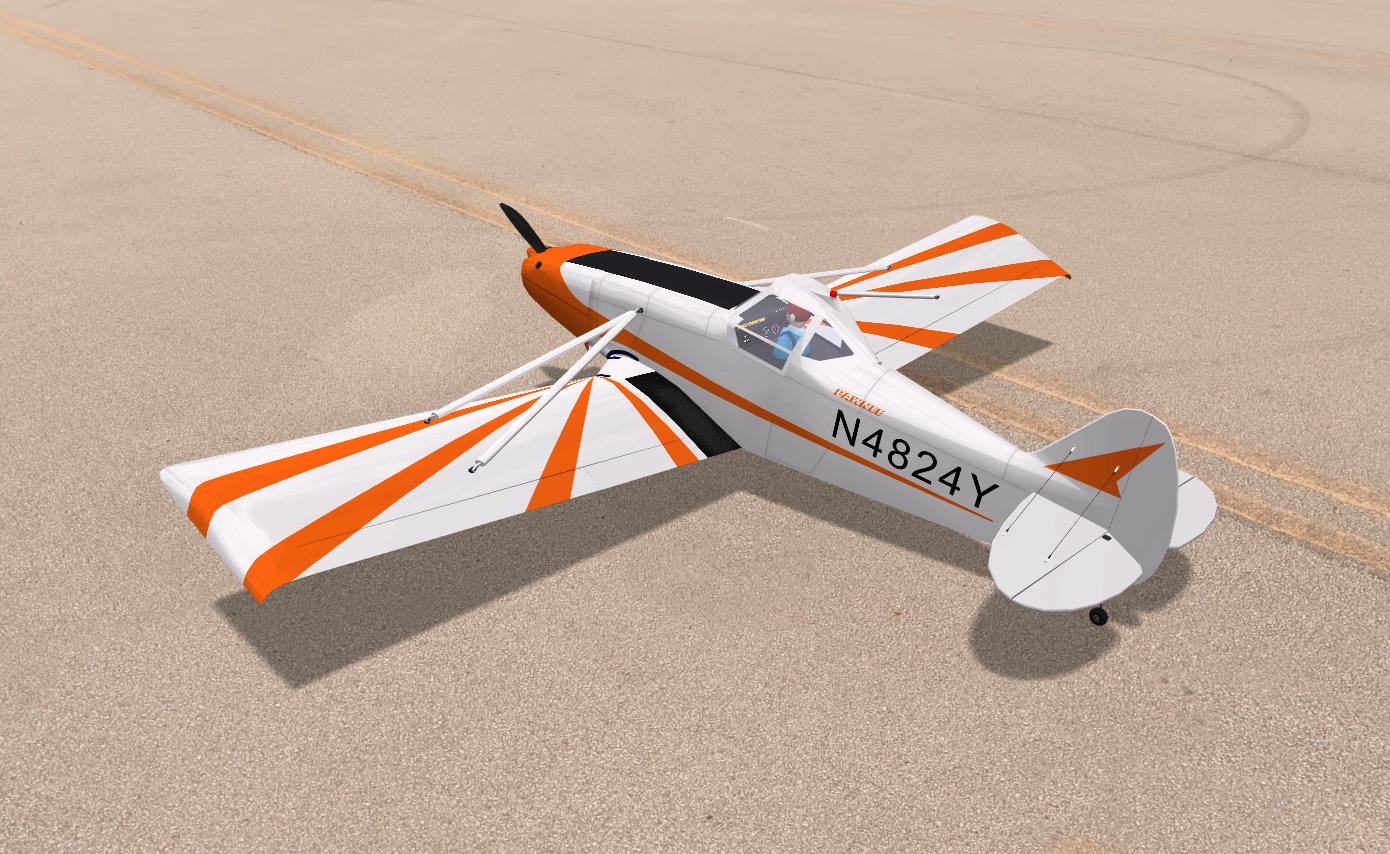
This DLC adds a new trim scheme for the 30%-scale Pawnee: an orange sunburst. The original Pawnee has been in SeligSIM for a while in Peter Goldsmith’s multicolored diamond trim scheme. DLC-3 is a “re-skin” of that same model, with the textures redone as an orange sunburst. It is free, and it is the first DLC that you add yourself using the SeligSIM Power Tools Aircraft list manager.
Installation instructions:
After running this installer, to complete the installation of the new airplane, follow these steps:
Open SeligSIM Power Tools.
Navigate to the Aircraft section.
In the “Add New” group at the bottom, select the new Pawnee and click “Add New”. The airplane will be added after the position of the cursor in the main list. Use the up/down “Move” arrows to reposition it.
Start SeligSIM. The first time it runs after an airplane DLC install, it shows an “Update Available” message asking whether to allow the update from a trusted source (www.seligsim.com). Click “Yes” to let it finish.
The new Pawnee will now appear in the airplane list.
Related link:
Selig’s Newsletter: A New Look for the 30% Pawnee: Orange Sunburst (DLC-3)
38.2.2. SeligSIM 2024.5b (v18.4)
April 28, 2026 (rev 4045)
This update includes all changes since SeligSIM 2024.5a (v18.3, rev 3670), which is the required base installation.
Run the update directly with standard permissions. Admin rights are not needed.
SeligSIM (SeligSIM.exe)
Added a wind streamer that displays at flying sites as a 3D animated windsock. The windsock responds to the current wind conditions, showing wind direction and relative speed at the field. The windsock is rendered with color banding. Multiple color schemes are available: orange and white (default), orange and black, and teal and white. The windsock is mounted on a pole at each flying site. Pole locations are defined per site. Use SeligSIM Power Tools to set the position for the desired flying site (not all are in the list). The windsock location is shown on the Map Widget as an orange circle. The wind streamer physics are modeled using the existing rope simulation code, providing realistic motion and draping behavior. Select a wind that includes turbulence to see the windsock undulate, otherwise it will stretch out straight.
Added a fourth map orientation: North Aligned. The Map Widget now offers four views, labeled 1/2/3/4 in the widget title.
Added manual zoom controls: “+” and “-” buttons for zoom in and zoom out. An “Auto” button toggles automatic zoom tracking on and off. When Auto zoom is ON, the behavior is as before (zoom follows the aircraft).
Added a landing circle overlay on the Map Widget. The landing circle toggles with the “L” key and corresponds to the landing target shown in the main view.
Added thermal circle overlays on the Map Widget. When thermal winds are selected, the thermal locations are shown as circles on the map. If other wind types are selected, no thermal circles are shown.
Expanded map scale buttons from [1.2] to [1.25] [1.5] [1.75] [2.0] [2.25] for finer control over the map view. Make your selection in Power Tools.
Improved on-screen messages when switching HUDs.
“RESET MONITOR” on-screen indicator renamed to “RESET STATUS”. The indicator turns amber when a reset is activated.
Added Tx Display gimbal configuration (internal to Tx.cfg files). A new optional parameter (TxGimbalConfigTREA) in Tx.cfg files allows configuring the Tx Display widget so that the on-screen stick movements match the physical controller. Previously, some airplanes (e.g., Ultima3, Supra, Stryker, Albatroz, Bubble Dancer) did not display sticks correctly.
Added multiple Tx texture selections. Users can cycle through different transmitter textures using the ‘E’ key. New textures include InertiaSoft, TacCon, gimbals-only, and transparent styles.
Added new default Tx texture for “Free Flight” transmitters, with “Tx” on the front and otherwise grey.
The Tx Display widget (E) shows the selected texture name on screen.
Redesigned the Position Widget to show current position, last position, and distance between the two points. This makes measuring distances in the sim much easier.
Fixed static reflections in body-fixed (F8) camera view. Previously, sphere-mapped reflections on aircraft surfaces did not change as the aircraft turned in the F8 onboard view. Reflections now respond to aircraft heading changes, matching the behavior seen in chase (F7) view.
Fixed inset camera window behavior during Flight Training and Recordings playback sessions. The inset window now shows “Disabled for Flight Training and Recordings” instead of a placeholder string.
Added soft shadow rendering option. Two methods are available: scaled expansion method (renders the shadow multiple times at progressively larger scales) and offset method (translates shadows in a radial pattern for uniform blur). Only the latter is currently exposed to the user. Default is ON.
Added elevation mesh wireframe overlay for terrain debugging. Displays the .ele terrain data with material-based coloring (grass = green, asphalt = dark gray, pond = blue, etc.). Supports configurable wireframe line width, alpha transparency, and fill mode. Uses polygon offset for proper occlusion so the airplane appears in front of the terrain overlay.
Added the ability to enable or disable panoramic occlusion at runtime. Default is ON.
Ground reflection rendering code added but currently disabled pending fade implementation.
Fixed joystick overlay showing zero axes when using non-FS One interfaces. The overlay now correctly finds and displays data from the active joystick device.
Added color legend lines next to each axis label in the joystick overlay. The color of each line matches the corresponding trace color for easy identification.
Added interface name display above the axis values in the joystick overlay (e.g., “Interface: Alpha40”).
Changed joystick overlay axis value display from percentage format to raw value format (-1.0 to 1.0) with increased decimal precision.
Added reverse axis display order option to the joystick overlay.
Added time history scroll speed options to the joystick overlay: 1x (~8.3 sec window), 2x (~4.2 sec), and 4x (~2.1 sec at 60 fps).
Time history recording now pauses when the simulation is paused.
Expanded servo position output from one set to three sets (servos1, servos2, servos3), covering up to 24 individual control surface deflections including ailerons (top/bottom, left/right), elevators, rudders, flaps, air brakes, and clamshell surfaces.
Added horizontal tail aerodynamic data to the Data Monitor. Added “A/C” prefix to identify aircraft aero data.
Added UVW velocity components for Aircraft CG in XYZ and NED coordinate systems.
Fixed Data Monitor text labels for velocity in XYZ and NED.
Added more decimal places to g-load parameters for increased precision.
Added per-element point collection (SampledPntsElement.txt) for gathering position data one element at a time.
Fixed-width formatted output for sampled points (9-character width, 2 decimal places, 2-space separators).
Added collision mesh (walls and ceiling) to indoor pano sites.
Added second court to a flying site (Evergreen Court).
Various tweaks to flying site initial conditions and map data.
Added ground reaction sounds to Alpha 40.
Added ground reaction sounds to Alpha 60.
Reduced maximum ground reaction force for less bounce on hard landings and crashes (Alpha 40 and Alpha 60).
Added new Tx textures for the ‘E’ key Tx Display.
Adds initials to sky names.
Fixed MiG-15 elevator separating from horizontal tail during crash. The parent of the horizontal stabilizer parts was incorrectly set, causing the elevator to displace from the tail on breakup.
Fixed aileron disappearing on certain aircraft models. Corrected the POSVEC pivot point values that caused depth sorting issues with translucent polygon rendering.
Fixed bug with stick playback during recorded flights and lessons.
Fixed scoreboard labels: “Player1” and “Player2” changed to “Pilot 1” and “Pilot 2”.
Fixed HOT (Height of Terrain) facet count not updating during flight. Previously the count only updated during ground contact.
Fixed OverlayGfx text visibility on light backgrounds by adding shadow text technique (black text with white offset).
“Landing Distance” renamed to “Distance to Target”.
“Toggle Landing Distance” renamed to “Toggle Landing Target”.
“RESET MONITOR” renamed to “RESET STATUS”.
Loading screen messages restyled to “Loading - Aerodynamics …” format for improved readability.
Brake messages improved with clearer text.
Wind speed and direction change messages now use black font for better visibility (previously green, which was hard to see).
“w/” changed to “with” in fuel messages.
“Can’t” changed to “Can not” in error messages.
Orientation Trainer renamed to “Silhouette Flying (Orientation Trainer)”.
Side friction help text clarified: “more slick when sliding sideways, e.g., on ice”.
Added “Launch SeligSIM Power Tools for expanded options” text to top of the SeligSIM Options | General page.
Expanded UDP output parameters for external applications and hardware-in-the-loop (HIL) use: added prop torque (shaft torque in ft-lbs), prop RPM, IMU acceleration in body axis, wind velocity at CG in NED axes, crash flag, height above terrain, and throttle position. UDP features not yet exposed to users.
Reordered UDP roll, pitch, yaw to standard order.
Corrected sign conventions on several UDP parameters.
Added UDP.cfg.sample-01 as a reference configuration.
Fixed null pointer crash when sending crash flag over UDP for aircraft without breakable parts (e.g., Albatroz).
When flying the UFO, the Map Widget displays a dark magenta crosshair icon instead of the standard red aircraft triangle. UFO features not yet exposed to users.
Added ‘u’ key to reset UFO position to starting location.
Added ‘0’ key to reset UFO to zero elevation.
Added ‘c’ key to clear the sampled points buffer (element mode).
UFO position now shows on the Map Widget with a dark magenta crosshair and trail dots.
Added exponential response (expo) for smoother UFO stick movements around center. Rudder stick has less expo to maintain responsiveness for up/down movement.
SeligSIM Power Tools (SeligSIM_PT.exe)
SeligSIM Power Tools is a companion configuration program that runs separately from the main simulator. It provides expanded options not available in the simulator’s standard menus and writes settings to a PT_settings.txt file. When SeligSIM.exe launches, it reads these settings and applies them.
Added Icon Preview window. A floating, resizable window that shows the icon image for the currently selected flying site, sky, aircraft, or wind. The window supports PNG, TGA, JPG, BMP, and DDS (DXT1/DXT3/DXT5) image formats. The window title updates based on the selected category. Window position and size persist between sessions.
Added Info window. A consolidated information window that shows description and specification data for the currently selected item. Aircraft show two tabs (Description and Specifications); other categories show a single Description tab. Info data is parsed from .fld files (sites), SunSky.txt (skies), Info.cfg (winds), and Info.cfg (aircraft).
Added display formatting in the Info window: spaces are automatically inserted between numbers and unit abbreviations (e.g., “1397mm” displays as “1397 mm”) and after commas followed by letters. Original files are not modified.
Added selection index display. The current list position [N] is shown right-justified in both the Icon window and the Info window tab bar.
Added Show Icon Window and Show Info Window checkboxes to all five category sections (3D Sites, Pano Sites, Aircraft, Skies, Winds). Closing a window via its X button unchecks the corresponding checkbox. Both settings persist to PT_settings.txt.
Added Wind category icon support. Wind folders can now display an icon image (IconLarge) in the Icon Preview window, consistent with Flying Sites, Aircraft, and Skies. For “Thermal Set” winds, the locations of the thermals are displayed on the icon.
Added arrow key navigation for all list widgets (3D Sites, Pano Sites, Aircraft, Skies, Winds). Lists can be navigated using Up/Down arrow keys with rate-limited key repeat (175 ms).
Added “Apply settings to all lists” checkbox. When enabled, the “Show filenames” and “Lists Width” settings sync across all five categories.
Added Show filenames option. An optional display of the folder name for each item in all selection lists. Enabled per-category or synced across all.
Added Lists Width setting. Adjustable width for the list widgets, saved per-category or synced across all.
All list settings (Show filenames, Lists Width, Show Info Window, Show Icon Window) persist to PT_settings.txt.
Refactored the Panorama site list editor with improved helper functions.
Added 3D site list editor for adding and managing 3D flying sites.
Added Aircraft | Airplane edit capability.
Added Skies edit list for adding and managing sky panoramas.
Added Winds edit list for adding and managing wind configurations.
Fixed icon preview requiring two clicks to update when switching between archived lists or between categories.
Added “Windsock (experimental)” configuration section.
Added option to show or hide the windsock at flying sites.
Added option to show or hide windsock messages on screen.
Added option to show or hide the windsock location on the Map Widget overlay.
Added windsock color selection: orange and white (default), orange and black, and teal and white.
Added HUD scaling slider to adjust the HUD to different sizes.
Black HUD is now first in the HUD selection list (swapped with Green).
The currently selected HUD index is shown on screen when cycling HUDs.
Added option for black background on the upper-right “Flight Mode” string display.
Added Reset Status widget toggle. This option controls whether the Reset Status indicator is shown on screen at startup. Default is ON (shown).
Added additional reset buttons with different values.
Added Tx Display texture selection. Users can select a transmitter texture for the ‘E’ key Tx Display widget from a list of available textures. The list is read from Graphics\RadioEquip\Controllers\TxDisplayList.txt. Two styles are supported: Style 1 (original stick positioning) and Style 2 (sticks higher and closer together for bulkier Tx images).
Added option to enable or disable Mixing edits on the Edit Transmitter screen. Disabled by default to prevent stability issues.
Added option to enable or disable Flight Mode edits on the Edit Transmitter screen. Disabled by default to prevent stability issues.
Added hand launch settings section with configurable parameters. Not yet expose to users.
Added Map Widget offset options for repositioning the map on screen.
Added support for UVW for Aircraft CG in XYZ and NED coordinate display.
Added option to enable or disable soft shadow rendering. Default is ON.
Added soft shadow parameter sliders. Three sliders appear below the “Use Soft Shadows” checkbox: Offset Radius (0.0-0.2, default 0.04), Offset Samples (1-16, default 12), and Offset Rings (1-10, default 3). Sliders are disabled when soft shadows are unchecked. A Reset button restores defaults.
Added option to enable or disable panoramic occlusion at runtime. Default is ON.
Parameters for ground reflection alpha and max distance are available for future use. Not currently exposed to users.
Added FOV 65-deg and 70-deg preset buttons.
Added Show Collidable Meshes checkbox (developer tool section) to display collision mesh overlay.
Added Show Elevation Mesh checkbox (developer tool section) to display elevation terrain data as a colored wireframe overlay. Options include fill mode, wireframe mode, material-based colors, alpha transparency, occlusion, and line width.
Added Show Winds (thermals) checkbox to display thermal locations during a flight session.
Developer tool checkboxes are now labeled “(developer tool)” for clarity.
Added detailed help marker text for the Tx Diagnostic Overlay.
Added help marker text for multiple developer overlay options.
UI reorganization: Flying Sites, Aircraft, Skies, and Winds sections moved after Standard Options for a more logical flow.
Renamed headings: “Flying Site Lists” to “Flying Sites”, “Aircraft Lists” to “Aircraft”, “Sky List” to “Skies”, “Wind List” to “Winds”.
Various improvements to help marker text throughout the program for clearer descriptions.
Added physics settings info text explaining disabled collision and flat earth options.
Clarified side friction help text: “more slick when sliding sideways, e.g., on ice”.
Clarified orientation trainer help text with “Hone your skills” phrase.
Renamed Orientation Trainer to “Silhouette Flying (Orientation Trainer)”.
38.2.3. DLC-2: 32K Sci-Fi Indoor Site
February 6, 2025

This DLC adds a 32K Pano of the Sci-Fi Hexadome 6b. It has the viewing position situated close to the wall and 62 feet above the deck, giving the pilot a downward view of the floor. The ceiling is 125 feet higher than the viewing point. This panorama is “32K”, being 32,768 x 16,384 pixels in size. It is composed of 16 tiles that are each 8K in size.
Installation instructions:
After running this installer, to complete the installation of the new flying site, follow these steps:
Open SeligSIM Power Tools.
Navigate to: Flying Sites > Panorama Sites.
Click “Add New” to add the new panorama site. The site will be added after the position of the cursor in the main list.
Related link:
Selig’s Newsletter: 32K Sci-Fi Panorama and Creating Custom Panorama Flying Sites
38.2.4. DLC-1: Indoor Flying Site
August 22, 2024

This DLC has the above indoor panorama in 16K and 32K resolution. Some PCs may struggle to run the 32K pano smoothly due to the demands on graphics hardware and VRAM.
Installation instructions:
After running this installer, to complete the installation of the new flying site, follow these steps:
Open SeligSIM Power Tools.
Navigate to: Flying Sites > Panorama Sites.
Click “Add New” to add the new panorama site. The site will be added after the position of the cursor in the main list.
Related link:
38.2.5. SeligSIM 2024.5a (v18.3)
August 22, 2024 (rev 3670)
This new major release includes all prior releases and updates.
This 2024.5a version mainly includes updates since the last major version 2024a.
All prior DLC are included with 2024a, except the large 32K Sci-Fi pano DLC, which will be downloadable separately as a DLC for SeligSIM 2024.5a.
Admin rights for installation is no longer needed. Run the installer directly with standard permissions. The simulator will install to C:\SeligSIM 2024.5. More about the new installation method is described in Selig’s Newsletter dated August 23, 2024.
Adds horizontal tail data to the Data Monitor in SeligSIM Power Tools.
Various minor changes and fixes.
Installer file is named: SeligSIM_2024-5a_Full_Installer.iso
How this new version is named:
SeligSIM 2024.5 - Software named for release year
SeligSIM 2024.5a - First release (a) for this major release 2024.5
v18 - New version number that counts from year first released (2006)
v18.3 - Third release of version 18
rev 3670 - 3670th rev to the software repository since 12/2009
To install under Windows, download and locate the downloaded file ending in “.iso”. Right-click on this file and select “mount”. It will appear as a DVD drive on your computer. Find the installer in this new drive, and double-click to start the installation. As with previous versions, Windows might ask for your permission during installation and when you run the program.
Run the installer directly with standard permissions. No admin rights needed.
Sign up for the newsletter to get notifications of updates and new DLC.
https://michaelselig.substack.com/
If you enjoy SeligSIM and would like it to continue, please make a donation to support its ongoing development.
https://www.paypal.com/donate/?hosted_button_id=YF62Q5XYS3CB8
38.3. SeligSIM 2024
38.3.1. DLC-2: SAE Heavy-Lift Albatroz Aero Design
July 5, 2024

This DLC adds the Brazilian SAE Aero Design RC model for SeligSIM. The Albatroz Aero Design RC airplane is the Brazilian UDESC (University of the State of Santa Catarina, Brazil) 2023 entry in the SAE BRASIL AeroDesign competition. This airplane competed in the Micro Class. The requirements for this class include maximizing payload weight while designing for a timed disassembly to fit inside a small container. Another requirement is takeoff from an elevated platform that is 165 inch (4.2 m) long.
Related link:
Selig’s Newsletter: SAE Heavy-Lift Albatroz Airplane Lands in SeligSIM
38.3.2. Update 2024b (v18.2)
July 5, 2024 (rev 3656)
Updates SeligSIM 2024a to SeligSIM 2024b.
Adds support for the Albatroz Aero Design airplane. Download and install the Albatroz Aero Design airplane DLC #2 separately.
Adds improved Ultra Stick Lite wheel graphics.
Requires prior installation of SeligSIM-2024a-installer.iso.
This update file was named: SeligSIM-2024b-Update-18002-3656.exe.
Install instructions: Install as Administrator.
If you enjoy SeligSIM and would like it to continue, please make a donation to support its ongoing development.
https://www.paypal.com/donate/?hosted_button_id=YF62Q5XYS3CB8
38.3.3. DLC-1: Indoor Flying Site
April 9, 2024
This DLC has the above indoor panorama in two resolutions: 16K and 32K.
If you’ve been looking for the ultimate indoor flying site, this new DLC might be a match. The indoor space measures 1188 ft (362 m) long, 886 ft (270 m) wide, and 295 ft (90 m) high, giving a floor space of 1,052,065 sq ft (97,740 sq m) - 24.15 acres of unobstructed flying space!
A few pictures of the site are shown on the Substack link below. The meanings of the resolution “16K” and “32K” are also discussed there.
Some PCs may struggle to run the 32K pano smoothly due to the demands on graphics hardware and VRAM.
Installation Instructions
- After running this installer, to complete the installation of new flying sites, follow these steps:
Open the SeligSIM Power Tools program from the SeligSIM folder in the Windows Start menu.
In the Power Tools, navigate down to the menu item: Flying Sites | Panorama Sites.
Click on the “Add New” button to add each new site to your list of panorama sites. The sites will be added after the position of the cursor in the main list.
Start SeligSIM, and select the new flying site from the Pano list (panoramas).
For detailed instructions on using the SeligSIM Power Tools, refer to this manual page:
https://www.seligsim.com/manual/powertools.html
Related link:
38.3.4. SeligSIM 2024a (v18.1)
March 25, 2024 (rev 3625)
This new major release includes:
Re-branding to “SeligSIM” from “FS One”. (The simulator is also marketed as “FS One”.)
For more information, visit the SeligSIM RC Flight Simulator website at: https://www.seligsim.com
New SeligSIM graphics, including program icon.
This 2024a version mainly includes updates since FS One 2022e.
All prior DLC are included with 2024a, except the large 32k Sci-Fi pano DLC, which will be downloadable separately as a DLC for SeligSIM 2024.
- Airplanes added since FS One 2022a:
Bubble Dancer
J-3 Cub 21 ft (60% scale)
Yak 54
Yak 54 Tail Sitter
Yak 54 Canted Tail Sitter
Swift S-1 Jet
Swift S-1 Jet Full Scale
- Pano flying sites added since 2022a:
TMFK summer flying site
TMFK winter aerial flying site
Sci-Fi spaceship interior
- Added an abundance of new features to SeligSIM Power Tools, including:
Camera walk speed, trolley speed, default field of view
Checkbox to turn on/off camera autozoom at startup
Settable aircraft, pilot eye, and pilot stamp start positions.
Settable landing target offsets
Show CG, datum, and contact points and forces
Hand launch settings (too numerous to document presently)
Launch line anchor location (stake position)
Sky rotation offset
Many flight path trace settings
Adds more Data Monitor parameters to view at runtime, e.g., air density.
Unlocks more Developer Overlays to see what’s under the hood
Controller options (that should not be changed except in special cases)
Settable wind widget colors
Brakes indicator (“ON” or “OFF”)
Added collision data to Hangar 4b pano site, and various other changes to Pano site data.
Added F8 bird’s eye view to Bobcat jet, Alpha 40 and other airplanes.
Ultra Stick graphics improvement (nylon bolts).
Tweaks to gear doors on Swift (fit and pivot) and wheel location.
Bubble Dancer spoiler poly fixes.
Cap 232 wheel texture tweaks for improved realism.
Fixed to Yak 54 elevator texture mapping (a few tris tweaked).
Improvements to Alpha 40 Evolution engine sounds for more realism.
Added pushrods to Showtime graphics models.
Added pushrods to Extra 260 EFL graphics model.
Added pushrods to Alpha 40 graphics model.
Added pushrods to Four-Star 60 graphics models.
Better engine sounds for Pawnee (full scale variants).
Tweaks to some field landing targets.
Spinner tweaks on the Ultra Stick Lite.
Wheel brakes added to full scale and 190-in span Pawnees.
Added missing cam gear housing on Ultra Stick Lite Saito 180 engine.
Fixed an inset camera behavior (“i” key camera).
Made camera selections more consistent across pano and 3D sites.
Added fence collision object to pano site: Worthington County Airport.
Various UI selection description tweaks.
Added wheel side skipping/bouncing to SIG Four-Star 60 airplanes.
Texture graphics improvements on Alpha 40.
Various “internals” tweaks to wheel ground reactions.
Removing references to “FS One” thanks to re-branding decision.
Added new generic Tx icon. Keep “Universal Tx” icon for prior owners of FS One v2 interfaces.
Increases Pawnee texture resolution (from 1k to 2k).
Removed list of transmitters in Tx selection list. The transmitter is auto-selected when making the airplane selection.
Replaces 2022a main screen background with image of the: Bowlus-du Pont 1-S-2100 Senior Albatross “Falcon” vintage sailplane Photo credit: Michael Selig Location: Steven F. Udvar-Hazy Center in Chantilly, VA
Added transmitter group to allow for users to fly the simulator with the programming on their own transmitter. See the User Manual chapter: “Use Your Own Programming.”
Removes above photo background from all screens except main screen. Replaced with solid deep blue.
Airplane editor now disallows editing max/min deflection limits. Description of the parameter is updated.
How this new version is named:
SeligSIM 2024 - Software named for release year
SeligSIM 2024a - First release (a) for this year (2024)
v18 - New version number that counts from year first released (2006)
v18.1 - First release of version 18
rev 3625 - 3625th rev to the software repository since 12/2009Installer file is named: SeligSIM-2024a-18001-Full-Installer-3625.iso
If you enjoy SeligSIM and would like it to continue, please make a donation to support its ongoing development.
https://www.paypal.com/donate/?hosted_button_id=YF62Q5XYS3CB8
38.4. FS One 2022
38.4.1. FS One 2022 DLC-5
Downloadable Content
May 9, 2023
Added two Yak 54 tail sitters. Free download along with all past DLC (downloadable content for FS One 2022).
Newsletter: https://michaelselig.substack.com/p/experience-the-thrill-of-tail-sitters
Video: https://youtu.be/ZcrKMSDUuqY
38.4.2. FS One 2022 DLC-4
Downloadable Content
April 24, 2023
Added a giant 60% scale J-3 Cub. This matches the size of the Bill
Hempel 60% scale Super Cub.
- The action camera mounted above the cockpit on the 21 ft span J-3 Cub was created by Alexandre Avranches and is licensed under Creative Commons Attribution.
- The action camera mounted above the cockpit on the 21 ft span J-3 Cub was created by Alexandre Avranches and is licensed under Creative Commons Attribution.
Newsletter: https://michaelselig.substack.com/p/giant-60-scale-j-3-cub-with-a-21
38.4.3. FS One 2022 DLC-3
Downloadable Content
April 6, 2023
Added [1] the TMFK flying site in the summer time and [2] the Modelcity site in Hluboke Masuvky, Czech Republic.
TMFK photography by Simon Inns and published under the CC BY 2.0 license. https://www.flickr.com/photos/simoninns/
Thanks to Peter Maissinger, manager at Modelcity, for permission to include the new Modelcity site.
Newsletter: https://michaelselig.substack.com/p/two-new-flying-sites-one-video-discussing
38.4.4. FS One 2022 DLC-2
Downloadable Content
March 8, 2023
Added a couple of Sci-fi/spaceship themed flying sites. The “show notes” at the link are worth reading. One is a 32k size panorama – the largest used in an RC simulator as far as I am aware. The detail is incredible.
Newsletter: https://michaelselig.substack.com/p/ultra-high-resolution-32k-panorama
38.4.5. Update 2022e (v17.2)
February 25, 2023 (rev 3310)
Added jet-powered 44% scale and full scale Swift S-1 sailplanes.
Wingspans: 18 ft (5.5 m) and 41.6 ft (12.68 m)
- Updated all Swift S-1 gliders:
New wing airfoil data
More gear damping
Increased wheel braking with down elevator
Less wing tip friction (dragging friction)
Better energy dissipation on crash landings
Crash/contact sounds
Revamped wing downwash data, and many other small changes.
Adjusted hingeline on ailerons
Reset pre-position data for perfect placement on ground
Adjusted 3D rotating view positioning
Increased electric power on Swift Park Flyer
More Swift details are here:
https://michaelselig.substack.com/p/new-swift-s-1-jet-sailplanes-in-fsUpdated FS One Power Tools (PT) 2022e.
Various other fix updates.
This update included all previous FS One updates.
Required prior installation of FSOne-2022a-installer.iso.
This update file is named: FSOne-Updated-To-2022e-17002-3315.exe
Known bug: Making a fast selection of a towplane recording for aerotowing can cause a crash. Making the selection slowly or turning off 3D rotating airplane views avoids the crash. The selection is: Options | General | uncheck Rotating 3D views.
38.4.6. Update 2022d (v17.1)
January 10, 2023 (rev 3241)
Updated FS One 2022a or later to FS One 2022d.
Updated FS One Power Tools to version 2022d.
Added the 117-in span Bubble Dancer RES sailplane.
Added Bubble Dancer graphics model by Mark Haley. https://michaelselig.substack.com/p/bubble-dancer-res-sailplane-ready
Added Orientation Trainer gadget, accessible via FS One Power Tools (PT) 2022d.
Adjusted view parameters for some 3D aircraft rotating views in the aircraft selection window.
Various other minor updates.
38.4.7. FS One 2022 DLC-1
Downloadable Content
December 6, 2022
This DLC added an aerial pano of the TMFK (Tullinge Modellflygares Klubb) club flying site in Tullinge, Sweden. Photography by Simon Inns and published under the CC BY 2.0 license: https://www.flickr.com/photos/simoninns/
- Install this site using the FS One Power Tools (PT) app.
Click on the “Flying Sites” tab in FS One PT app.
Select the “TMFK Winter Aerial”.
Click “Add”, and then use the up/down arrows to position it in the list.
Power Tools usage instructions:
https://www.fsone.com/manual/getting_started_running.html#fs-one-power-tools-extras
38.4.8. Update 2022c (v16.3)
December 2, 2022 (rev 3215)
Updated FS One 2022a or later to FS One 2022c.
Included NEW application: FS One Power Tools.
This update included all previous FS One updates.
Required prior installation of FSOne-2022a-installer.iso.
This update file was named: FSOne-Updated-To-2022c-16003-3215.exe
HOW TO RECEIVE UPDATE NOTICES
38.4.9. Update 2022b (v16.2)
November 12, 2022 (rev 3186)
Updated FS One 2022a to FS One 2022b.
Added the Yak 54 110-in span 3D/Aerobatic airplane.
Added Yak 54 graphics model by Chris Wehner (W3), modified by InertiaSoft.
Added new background image to user interface (menus).
Fixed artifacts in some skyscapes.
Updated Focke-Wulf Fw 190 with more drag.
Moved targets in bomb drop game (Frasca Field and New Holland).
Made Inset Window Widget binocular view more perfect (i.e., less lag).
This update included all previous FS One updates.
Required prior installation of FSOne-2022a-installer.iso.
This update file was named: FSOne-Updated-To-2022b-16002-3186.exe
38.4.10. FS One 2022a (v16.1)
August 23, 2022 (rev 3095)
Full New Release of FS One 2022a (v16.1, rev 3095) - Changes made to support practically any USB joystick controller. - Physics updates made to nearly all airplanes since last release. - This version included 140 airplanes (original scale and scaled variants). - To get started, follow the link to the online User Manual: https://www.fsone.com/manual/ - How this new version was named:
FS One 2022 - Software named for release year
FS One 2022a - First release (a) for this year (2022)
v16 - New version number that counts from year first released (2006)
v16.1 - First release of version 16
rev 3095 - 3095th revision to the FS One software repository since 12/2009
This version was free to download.
Installer file was named: FSOne-2022a-installer.iso
Maintenance Release for FS One 2022a (v16.1, rev 3115)
September 20, 2022 (rev 3115)
Added missing “DataFile” transmitter used with single pilot towing.
Updated Sbach342 airplane files with SCAS for 5 ch support.
Installer file was named: FSOne-2022a-update-16001-3115.exe
To get started, follow the link to the online User Manual: https://www.fsone.com/manual/
38.5. FS One V2
38.5.1. Update 2.8.2
December 14, 2021 (build 2907)
This update includes all previous V2 updates and aircraft.
Added a new version of the Four-Star 60, labeled “R2022a”. It is more agile and includes ground reactions updates, aero updates, sound updates, and more.
Added a “Binocular” view as the first camera for the inset camera window widget, via the i-key.
Added the inset camera window gadget to Pano fields.
Updated below mentioned in 2.8.1 are new and only made public in this release.
Updated some camera names and other improvements (F1, F2, … keys).
Fixed minor bug in zenith view in panos (v2.7.1 included previous fixes).
Install instructions: After downloading the update, install the update as Administrator. When complete, start FS One V2. When FS One asks if you want to install the updates from a trusted source, click “Yes” for each prompt. These updates may take 30+ secs to install. Only install updates from a trusted source.
38.5.2. Update 2.8.1
April 23, 2021 (build 2877)
This version 2.8.1 includes all previous V2 updates and aircraft.
Updated help overlays.
Updated help manual.
This update is already included in the new Full Release 2.8.0.
- Full release 2.8.0 (build 2865) - April 22, 2021
This version 2.8.0 includes all previous V2 updates and aircraft.
Updated help overlays.
Updated help manual.
38.5.3. Update 2.7.1
April 2, 2021 (build 2857)
This update includes all previous V2 updates.
Fixed finish line timing for pylon racing.
Updated all 2-pylon race courses. Course lengths range from Giant Scale F1 (1600 ft @ Frasca Airport) to micro indoor (225 ft @ Hangar 4).
Updated new indoor “Hangar 4” panorama flying site to have a maximum resolution of 16k (16,384 pixels wide), double from before.
Copied 3-pylon F3D courses to generic 3-pylon courses
Removed 4-pylon courses
Replanted some trees at Bryce Field to make room for Giant Scale pylon racing course
Updated landing distance target (“L” key) with high resolution image. The diameter is 25 ft.
Added more detail to Big-T runway map (displayed via “M” key)
38.5.4. Update 2.7.0
February 21, 2021 (build 2826)
This update includes all previous V2 updates.
Added the F3D Ultima 3 pylon racer designed by Borje Ragnarsson, with Thomas Eriksson offering piloting feedback/tuning on this FS One model. Ultima 3 specifications: Wingspan: 70 in (1778 mm), Weight: 5 lb (80 oz) (2.27 kg), Max flight speed near 235 mph (378 kph) with propeller running near 34,000 RPM
Added F3D pylon race courses
Added new indoor hangar panorama flying site - “Hangar 4”
Added more default camera view selections (in Options | General)
Fixed minor graphics issue with Hangar 9 UltraStick airplane
Added cliff edge/outline to map for Jockey’s Ridge panorama site
Other minor fixes and UI changes performed
Known issue: For F3D, the finish line is not at the finish line but when crossing the center line of the track after passing pylons #2 and #3 on the last lap of the race.
38.5.5. Update 2.6.0
September 27, 2020 (build 2717)
This update includes all previous V2 updates and aircraft.
Added the 81-in span Sundowner sport plane/racer from Hangar 9.
Included a 95-in span scaled-up version of the Hangar 9 Sundowner. It is similar in size to the aircraft flown in the USRA Formula One GT class. Top speeds reach around 160-165 mph in level flight.
Also, includes a 110-in span scaled-up version of the Hangar 9 Sundowner. At 110 in wing span, it comes in at 40 lb and has a maximum airspeed above 200 mph.
Increased the turn radius of the Alpha 40 and Alpha 60 Trainers for better ground handling.
Rotated the runway for better orientation to pilot for the Castleton Track and Field panorama.
Various other minor updates and fixes performed.
38.5.6. Update 2.5.1
April 29, 2018 (build 2627)
Fixed total energy variometer response to thermals.
Added new flight test site “Infinity Space” with no ground. Practice without crashing.
38.5.7. Update 2.5.0
March 13, 2018 (build 2601)
This update includes all previous V2 updates and aircraft.
Added field-of-view (FOV) angle sweep to map display (‘m’ key), extending 800 ft from the pilot’s eye.
Added support for multiple HUDs: simple (4 colors), intermediate (1 color), and full (1 color). Full HUD (last in cycle) is best viewed from F8 onboard cameras. Requires ‘h’ key to cycle.
Fixed issue with hi-start rope calculations, improving accuracy.
Faster tow rope calculations.
Created 15 new hi-starts (zip-start, up-start, standard, heavy duty, mega, insane, and epic) including information on recommended launch length for each.
Added ability to use a captured tow hook, requiring ‘Insert’ key to release.
Added time delay that locks the tow line to the aircraft for 3 sec to allow for startup/reset transients to decay.
Added towline “thump” sound on hi-start/winch towline release for Supra sailplane.
Changed smoke settings in Options | Smoke to make smoke more lifelike. Sized smoke for aircraft with wingspans around 100 inch. Requires resetting options via Options | Messages | Use Default Options on Shutdown.
Improved apparent mass calculations in aerodynamics.
Fixed occluding aircraft parts in rotating 3D aircraft selection views.
Improved shadows to be darker at noon (high sun elevation angle) and gentler at sunset.
Improved aircraft shadows, fading out with increasing distance from aircraft (along the direction of sunlight, not vertically), to approximate umbra becoming penumbra.
Reduced flickering of numbers in heads up display (HUD).
Faster camera calculations.
Updated runway coordinates to best fit for each flying site.
Removed needing to press ‘j’ to restart heli motors.
Added 100 ft high field camera to Arthur Field flying site, via F5 key.
Fixed sometimes duplicated aircraft names in Recordings.
Faster Runge-Kutta integration with equations of motion.
38.5.8. Update 2.1.4
April 19, 2015 (build 1961)
This update includes all V2 updates with: - Hangar 9 Spitfire - Focke-Wulf Fw 190 - Xtreme Machines Sbach 342 - SIG Four-Star 60 - Hangar 9 Cap 232G - Hangar 9 Extra 260 - BD-5J - plus many variants
Bundled extras: - Sbach 342 SCAS, electric powered, 5 variants (4 with SCAS, 1 without) - New NMPRA Electric Formula One (EF1) pylon racing course - All pylon course layouts improved
New features: - Many more hi-start towlines (various lengths and strengths, including Gorilla and Insane) - Recording playback includes rotating wheels and landing gear flex - Pylon cut conforms to AMA rules; map display improved - Brakes of tail-dragger 33% scale Spitfire activated by up elevator
New displays: - More inset cameras for 3D fields - Tension of hi-start and winch line - Camera name (‘;’ key) - Pylon race map view shows half-plane beyond next pylon (‘m’ key)
Visual refinements: - Smoother padlock views - Pano images touched up - Improved smoke for Bobcat jets - Quieter crash sounds for Extra 260 EFL - Aircraft receiver antenna removed from graphics
Performance optimizations: - Faster OpenGL frame rate (shadows, smoke, sparks, etc.) - Faster collision detection - Faster recording speed - Faster loading of recordings
Aerodynamics and physics refinements: - Improved drag calculation, considering Reynolds number effects - More precise hand launch, using a javelin-throw launch profile - Faster and more accurate bomb and bottle-rocket physics - More precise calculation of apparent mass - Faster throttle response on Extra 260 - More accurate gear flex on full-scale Ultimate TOC biplane
User interface improvements: - Suppressed HUD’s G-load during hand launch, hi-start pullback, and winch pullback - Removed limiters on alpha and beta measurement from HUD - Improved HUD data management/display and FPS - Clarified inset camera names (e.g., “North View” is now “View Facing South”) - Improved readability of towlines options page and selections - More readable colors, fonts, and text for pylon race statistics - Changed camera names to green (first camera) and white (later ones) - Increased resolution of aircraft’s path trace in map view (‘m’ key) - Upgraded prompt for version update to FS One user interface style - “USB Interface” heading added to indicate selected USB interface
Bug fixes: - Improved smoothness of F5 camera view for 3D fields. - Fixed texture glitch on house. - Reoriented F8 bird’s eye view so that north is up (for some aircraft, e.g., SBach). - Fixed spinner breakable part on UltraStick Lite. - Disabled smoke for electric aircraft.
38.5.9. Update 2.1.3
December 14, 2012 (build 1450)
- Added BD-5J high performance micro jet design by Jim Bede, plus four variants.
50%-scaled 102-in span model designed by Sean Cassidy, maker of the prototype molds for Bill Hempel’s BD-5J.
50%-scaled ARF version sold by Bill Hempel (uses the newer JetCat P140-RX turbojet with 32-lb static thrust). Historic link: http://www.billhempel.com/bd5/index.html (broken)
Full-scale 17-ft span versions with 240-lb and 325-lb static thrust produced by the Microturbo TRS-18 jet engine.
This update includes all previous V2 updates with Hangar 9 Spitfire, Focke-Wulf Fw 190, Xtreme Machines Sbach 342, SIG Four-Star 60, Hangar 9 Cap 232G, Hangar 9 Extra 260, and variants.
Cleanup: Removed channel string from Bobcat aircraft descriptions.
Map (‘m’ key) now shows targets for bombs and rockets.
Added racing pylons to map (in pylon race)
Fixed minor bug in transmitter editor.
Changed: pylon-racing timer changed from predicted finish time to current elapsed time. Also simplified current-lap display.
Added support for changes to pylon racing setups. Works with pylon extras download (build 1372).
Changed braking on 33%-scale Spitfire from activation with down elevator to up elevator.
Reduced volume for cut pylon buzzer (pylon racing).
Install instructions: After downloading the update, install the update as Administrator. When complete, start FS One V2. When FS One asks if you want to install the updates from a trusted source, click “Yes” for each prompt (three times). These updates may take 30 secs to install. If you are running Windows Vista and have questions about installing and UAC, see: https://www.fsone.com/q009378/
- Extras Download 2.1.2b (build 1372) - November 25, 2012
Updated to support new pylon racing features. To test out these new features, visit the FS One downloads page and install the Pylon Racing update (build 1372). Requires V2.1.3.
38.5.10. Update 2.1.1
November 5, 2012 (build 1358)
Changed elevator trim in Spitfire and its four variants.
This update includes all previous V2 updates with Spitfire, Focke-Wulf Fw 190, Xtreme Machines Sbach 342, SIG Four-Star 60, Hangar 9 Cap 232G, and Hangar 9 Extra 260 and variants.
38.5.11. Update 2.1.0
October 28, 2012 (build 1350)
This update includes all previous V2 updates.
Added the Spitfire and four variants.
Added dotted line aircraft flight path trace on map.
Removed antenna from Firebird, Ascent, Alpha40, and Stryker.
Repositioned exhaust smoke on MiG15, P-51, T-34, and Texan.
Improved pitch-yaw coupling for E-flite Ultimate and Extra 260 foamies.
Increased precision of recordings.
Fixed random missing smoke on Bobcat jet.
Updated map for Arthur Field.
Added tracking of maximum negative g-load and displays in HUD.
Changed scaling in variometer. Now it’s 100 fpm per tick.
Changed lag rate on variometer. Now it’s slower.
38.5.12. Update 2.0.9
February 4, 2012 (build 1170)
This update includes all previous V2 updates.
Fixed Scaling Wizard bug introduced in 2.0.8.
Tweaked hi-start color.
Updated Help Manual and Flight Manual.
Fixed minor aileron graphics issue on Sbach 342.
Moved branded transmitters in Tx list to new menu category: “FS One v2 Others”.
- Extras Download (build 1126) - January 1, 2012:
Added the Sbach 342 SCAS, electric powered, 5 variants (4 with SCAS, 1 without SCAS)
Requires: FS One V2.0.8 or higher. This extras download includes the RCX Sbach 342 with a “Stability and Control Augmentation System” (SCAS) that relies on gyros in all 3-axes. As it sounds, the SCAS system (similar to other systems currently available for micro flyers) adds stability, and this is especially noticeable in turbulence. The system also changes the behavior of the control sticks. Rather than directly controlling the surface deflections, the control sticks (pilot inputs) drive the roll, pitch and yaw rates, i.e., they turn into ‘rate commands’. In this mode, rolling harriers, knife edge flight and many more aerobatic maneuvers become much easier while the control system does most of the work (watch the surfaces move on their own in rolling harriers!).
Turn SCAS on/off with the gear switch (or key “0” for transmitters with only 4 channels).
38.5.13. Update 2.0.8
November 5, 2011 (build 1026)
This update includes all previous V2 updates.
Added Focke-Wulf Fw 190 A-8: 25% scale (span: 102 in, weight: 36 lb) plus 20% scale variant (span: 79 in, weight: 17 lb).
The 102-in span version is Giant Scale at 36 lb and similar to the Meister Scale RC model. The 20% scale is 79-in span with 17 lb and close to the Dave Platt Fw 190 model.
This airplane is the first in the FS One V2 Open Source Collection. The open source graphics files for the Fw 190 are originally from the open source FlightGear Flight Simulator and modified for use with FS One V2. These modified graphics files for FS One are also open source under the GNU GPL v2. As such, they are free to use, modify and distribute with few restrictions. Thanks goes to Karel Marciniszyn for converting this graphics model to work with FS One V2. We support the open source community and if you are interested in converting open source GPL models, please contact us.
Added new FS One Rewind feature activated using ‘y’ key. Rewind back and start the maneuver again! Airframe and propeller must be set to indestructible in the main options.
Corrected wobbly running propeller on Extra 260 and Sbach 342 airplanes.
Known issue: If the Scaling Wizard is used to edit an airplane, some cases may not scale properly. [This has been fixed in 2.0.8.1 (build 1170).]
38.5.14. Update 2.0.7
September 21, 2011 (build 958)
This update includes all previous V2 updates.
Added the Sbach 342 by RC Xtreme Machines, 40% scale, hyper-light (wingspan: 122 in, weight: 29.2 lb).
Fixed hover assist feature on/off behavior.
Reduced power on Cap 232 airplanes and tweaked idle engine sound level.
Corrected ground strike propeller radius for SIG Four-Star 60.
Changed “Sim Rate Multiplier” to “Physics Speed” in Options page.
Removed residual propeller torque after crash with broken propeller.
Fixed one tree texture graphics issue.
38.5.15. Update 2.0.6
August 12, 2011 (build 924)
This update includes all previous V2 updates.
Added the SIG Four-Star 60 (wingspan: 72 in, weight: 7.5 lb).
Added Ultra Micro Stryker with USAF trim (wingspan: 17 in, weight: 2.15 oz / F-27B Stryker variant).
Added new hover training widget. Press ‘o’ to start.
Known issue: If the Hover Training Assistant is ‘on’ when a flying session is stopped (with Esc key), it will be ‘on’ when flying starts again. Press ‘o’ to toggle the Hover Training Assistant and turn it ‘off’ while flying, then use Esc to stop flying.
Added bomb drop targets near pilot position on runway.
Updated to the Cap 232 and Extra 260 airplanes – more drag tweaks (a scosh higher drag).
Updated flying site descriptions.
Updated flight training lesson names in list.
Changed behavior: Flight training no longer changes airfield, sun/sky, wind selections of other flying modes.
Changed behavior: max G load in heads-up-display (HUD) cleared after reset or instant-up.
38.5.16. Update 2.0.5
May 14, 2011 (build 821)
This update includes all previous V2 updates.
Added the new Cap 232G 27%-scale by Hangar 9 (wingspan: 80 inch)
Included four Cap 232 variants in popular weights/sizes (wingspan: 80, 97, 108, and 130 inch).
Updated Extra 260 35%-scale by Hangar 9 - lower drag, less pitch coupling with yaw, re-tuned mixes, added air rush sounds.
Updated Brio - less pitch coupling with yaw.
Updated Stryker - increased drag to account for wing surface roughness.
Fixed bug with T-Rex heli gyro edit.
Updated edit Tx/servo interface - edit aircraft servos now disables edit Tx, and edit Tx now disables edit aircraft servos.
Improved mouse control when used to aim hand launch aircraft direction (when in Windowed mode)
Improved Tx copy/edit behavior when using one’s own transmitter for mixing
Corrected Scaling Wizard report - weight includes fuel.
38.5.17. Update 2.0.4
March 27, 2011 (build 702)
This update includes all previous V2 updates.
Added support for 2048 resolution with FS One V2 main USB Interface. Update your USB Interface firmware to 2048 resolution to turn on this new capability.
Added support for 2048 resolution with new 2nd-Player FS One V2 USB Interface.
Updated Hangar 9 35% Extra 260 - added more crash sounds, reduced airframe crash airloads (breaks easier in flight), fixed propeller contact points, updated onboard camera views (F8).
38.5.18. Update 2.0.3
March 5, 2011 (build 687)
This update includes all previous V2 updates.
New airplane added: Hangar 9 35% Extra 260 (in beta).
Improved multi-monitor support under Windows 7 and Windows Vista.
Improved switching between video modes (e.g., 1280x1024 @ 60 Hz).
Improved non-fullscreen mouse operation.
Improved wind compass graphics.
Moved aerodynamics data overlay text to work on smaller screens (in beta).
Added 8-Ch non-mixed Tx setup for control with real Tx computer radio settings.
Added additional checks when saving and naming custom aircraft and transmitters.
Clarified text in some dialog boxes.
Removed memory leaks.
Corrected Brio airplane drag reference point.
38.5.19. Update 2.0.2
January 14, 2011 (build 547)
This update includes all previous V2 updates.
Improved robustness of Tx editor.
Fixed Tx calibration for 3rd party interfaces.
Updated: When deleting a Tx, now the default is “Universal Tx”.
Changed: When copying a stock Tx, it uses the Tx configuration for the currently selected aircraft.
Fixed: Solves problem when running two player with only one controller. Second aircraft flies now with neutral controls on all channels.
Added: For airplanes, basic aerodynamics data overlay toggled on/off with keypad ‘+’ key. This feature in beta for engineering use only (may change later). When in use, slows down frame rate. Too see the full display, screen resolution should be at least: 1280 x 1024.
Added: Message that electric motors for airplanes cannot be killed with ‘k’ key (like glow/gas/jets airplanes).
38.5.20. Update 2.0.1
December 24, 2010 (build 516)
Fixed: Editing of some Tx’s in Tx Editor.
38.5.21. FS One V2
December 13, 2010
This is the first edition of the new FS One V2 (version 2.0.0).
High-Resolution Interface: Never before has an RC simulator had this much resolution between your transmitter sticks and computer. Version 2 comes with a new USB interface that has four times more resolution than before (10 bits, 1024 counts). It’s as smooth and accurate as your real transmitter.
Better Aerodynamics: Two years of research has improved FS One’s already best-of-breed aerodynamics. You’ll notice this most in 3D maneuvers, but even our beta testers who aren’t 3D hotshots volunteered that they could feel it.
Free Aircraft: Many high-quality aircraft are in the works. The new version 2 supports these free downloads from www.fsone.com. Among the first new airplanes will be the 35% scale Hangar 9 Extra 260.
Aircraft: Version 2 has over 40 stock aircraft. This new version bundles in the version 1 Hangar Pack for free. No more Hangar Packs to buy! Leader of the pack The Scaling Wizard by FS One turns any airplane into any size, physics included automatically. The number of airplanes is virtually limitless.
Panos and 3D Flying Sites: FS One has both. Fly on board or from the ground, in a 3D world or with photorealistic graphics. Free panos along with free airplanes.
Version 1 has reached ‘End of Life’: No more updates or aircraft. All our efforts are now in Version 2 and beyond.
Super Easy Transmitter Setup: A Calibration Wizard automatically assigns channels to 4- to 8-channel transmitters. No more long transmitter FAQs.
No TacCon!: With the best aerophysics, we’ve made it easy to get the best out of your simulator. Use your own transmitter, and what you feel in the sticks, you’ll feel at the field.
Fast Install: Installation is four times faster, and needs no CD-swapping.
Updated: Version 2 bundles in all updates to version 1.
38.6. FS One V1
38.6.1. Update 1.1
Added over 100 minutes of training material and over 40 lessons for helis
Moved the example transmitter location from the center to left of center. This reduces the chance that the transmitter will obscure the view of the aircraft, especially when on the ground.
Reduced engine sounds when viewing lessons, making it easier to hear the instructor’s voice.
Corrected the Physics Menu problems.
Improved support for Mode 1 TacCon units.
Added a “User Transmitter” category for fixed-wing radios.
This version includes all previous updates, plus the heli performance update.
Heli Performance Update for v1: This heli performance update improves the flight performance and realism of the heli models. Flight mode switches are reconfigured to match most heli transmitters with the flight mode switch on the left and the throttle hold switch on the right. Pre-existing heli models are retained in a new folder for access unmodified by the performance update.
38.6.2. Update 1.0.9
Corrected problem with helis encountering excessive yaw during startup, especially when starting while in stunt (or idle up) mode. For this fix to work properly, the “heli update” should be applied prior to applying the 1_0_9 update. If the update is applied prior to the heli update, simply reinstall the 1_0_9 update after installing the heli update.
Corrected undefined region for three position switch for heli TacCon controllers that were deployed with the heli performance update.
Improved update functionality to prevent duplicate list entries when repeatedly performing updates. This will eliminate multiple entries in the selection lists/categories.
Modified heli start positions to be closer to the pilot location. Heli start positions are now based on the size/class of the heli. For example, smaller helis are located closer than larger helis.
Modified heli start positions to allow three start attitudes/directions – pointed away, pointed left, and pointed right. The position can be set via the Options Menu.
Added heli landing targets. These landing targets can be turned on/off via the Options Menu. These targets are handy for learning to fly helis and for general practice of precision hovers. All flying sites do not support targets – for example, sites that are not flat near the pilot location do not support targets.
Modified calibration procedures for some TacCon controllers. This makes TacCon controllers after the Heli Update have the same calibration behavior as other heli and airplane TacCons.
Clarified calibration instructions for TacCon controllers. This should help users ensure that they click the InstantUp button for a proper and complete calibration.
Corrected the “Example Transmitter” to show proper axes when used with a heli.
Added “Flight Manual” link to the Aircraft Selection Menu and removed the Flight Manual link from the Main Menu.
Fixed minor P-factor bug in Edge 540 and J3 Cub aircraft aerodynamics.
Increased Edge 540 landing gear side force coefficient to make the gear have more grip when skidding sideways.
38.6.3. Update 1.0.8
This version was deployed with Hangar Pack 1.
38.6.4. Update 1.0.7
For hi-start and hand-launch starts, throwing angle was changed from 30 deg up/down to 90 deg up/down.
Fixed hand-launch glider throw direction bug.
Set all padlock cameras (F9/F10 keys) to have autozoom turned off initially. For these cameras, autozoom can be turned on with the ‘a’ key. Added two extra Reverse Padlock cameras to the F10 key.
Scaled airplanes, made using the Scaling Wizard (TM), now also scale camera distances proportionately. This change only applies to cameras enabled at 3D fields, e.g., cameras F5 and higher.
When using hi-start or winch, the u-key for InstantUp now resets the aircraft at its current position.
Corrected a typo in the mixing GUI.
Improved warning to users when using 16-bit color mode. (32-bit color mode is required for FS One).
Added the ability to properly detect the Windows Vista operating system.
Added an Updated folder and related software to support easy updates of aircraft, radios, and pilot figures.
Added the ability to provide individual flight manual supplements for aircraft.
Improved/updated the Help file.
FS One is now a registered trademark.
38.6.5. Update 1.0.6
Fixed sound problem for various types of sound cards. This fix involved working around incorrect capabilities data reported by the sound driver.
Corrected ParkZone SloV 11x3.7 prop data.
Corrected Circleville Stock Pavilion sun position.
Corrected ScaledUltimateTOC-FullScale information.
38.6.6. Update 1.0.5
Disabled screensaver and power management while sim is running. This will prevent the screensaver from turning on while FS one is active.
Modified Alpha 40 exhaust direction
Changed wind behavior to allow wind speed and direction changes, even if the wind speed is zero.
Corrected the discrepancy between the map display and the wind widget.
Added “Help” and “Flight Manual” links to Main Menu.
Added an automatic ability to determine if the “options file” is missing or corrupt, and if it is, automatically utilize the default options file.
Added a new logbook interface. This provides a nice way to review the total flight time for each aircraft.
Corrected a two player radio edit problem that caused problems when editing the “player 2” radio. Previously, if you edited a transmitter in the second position, it edited the transmitter in the first position. This now functions properly.
Updated some heli JR 6-Ch Emu transmitter files. The “JR 6-Ch Emu + FS One” Tx group has been changed so that Flight Modes now depend on the Tx channel assignments (like airplanes) and not the joystick axes assignments (Axis numbers). This simplifies things by removing a step when making a copy and editing the Tx in the Tx editor. The following files were affected:
RadioEquip/Tx/JREmu6Ch_FS1_Heli_BladeCP/Tx.cfg
RadioEquip/Tx/JREmu6Ch_FS1_Heli_JetCopterSX/Tx.cfg
RadioEquip/Tx/JREmu6Ch_FS1_Heli_ScaleHeli/Tx.cfg
RadioEquip/Tx/JREmu6Ch_FS1_Heli_Vigor/Tx.cfg
RadioEquip/Tx/JREmu6Ch_FS1_Heli_Voyager50/Tx.cfg
RadioEquip/Tx/JREmu6Ch_FS1_Heli_VoyagerE/Tx.cfg
38.6.7. Update 1.0.4
Corrected inertia tensor data scaling problem.
Modified the default_options.txt file to change default views (lagged views).
Added trademarks section to credits.
Expanded limits for max/min from -1.5/+1.5 to -2.0/+2.0 in Edit Transmitter menu.
Expanded limits for non-exponential percentages from -150/+150 to 200/+200 in Edit Transmitter menu.
Modified aircraft and transmitter name comparison to be case insensitive.
Added numbers to axis displays of Tx Selection menu (and ghosted-out inactive channels/axes)
Added numbers to axis displays of Tx calibration menu (and ghosted-out inactive channels/axes)
Added highlighting to the active axis during calibration
Added the ability to edit the Tx Description and 3-part name in Edit Tx menu
Corrected problem where some controllers could not fully complete the calibration sequence.
Fixed problem in Edit Transmitter menu when the Source input axis was adjusted.
Extended the Input Type drop-down list in the Select Channel Input dialog within the Edit Transmitter menu.
Fixed slider display problem when using joystick button input in the Select Channel Input dialog within the Edit Transmitter menu .
Corrected typo in Ultra Stick Lite (200 inch scaled version) description
Corrected typo in Edge 540 less expo Tx (name change)
Corrected Saito100 airplane engine file in airplane editor
Changed behavior of airplane hover damping weight parameter (2)
38.6.8. Update 1.0.3
Corrected CG limit adjustment problem that prevented a negative cg location.
38.6.9. Update 1.0.2
Corrected calibration problem that prevented a recalibration after the initial calibration was performed.